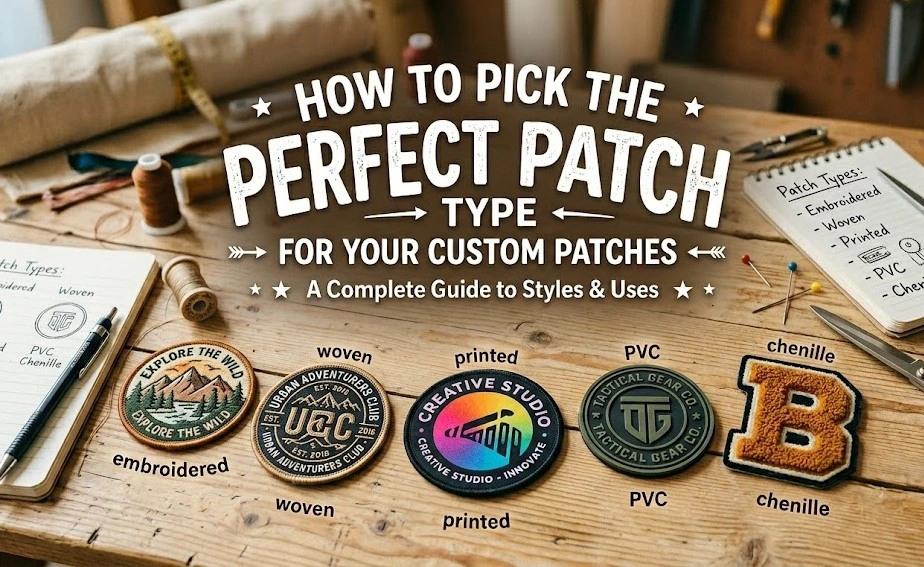
How to Pick the Perfect Patch Type for Your Custom-Made Patches
Not sure which patch to order? Your design already knows the answer. This guide helps you read it.
Start Here: The Question That Decides Everything
Before you look at pricing, minimums, or turnaround times, ask yourself one thing:
What does my design actually look like?
Is it a bold logo with thick lines and solid colours? Is it a detailed illustration with small text? Does it have gradients, shadows, or photographic elements? Is it going on outdoor gear that will get wet?
The answers to those questions point directly to the right patch type. Every wrong patch order the embroidered patch that came back with blurry text, the design that lost all its detail, or the patch that peeled off a wet bag after a fortnight happened because the patch type did not match the design.
This guide fixes that. Whether you are ordering custom-made patches for a footy club in Brisbane, a school in Melbourne, a small business in Perth, or personal use anywhere across Australia, the same logic applies.
Quick Answer
Bold logo with solid colours: Embroidered patch
Fine detail and small text: Woven patch
Gradients, photography, or lots of colours: Dye sublimation patch
Outdoor or waterproof use: PVC patch
Vintage or classic look: Felt patch
Complex design that needs both texture and detail: Combination patch
The 6 Patch Types: Plain English Explanations
1. Embroidered Patches: The Classic Choice
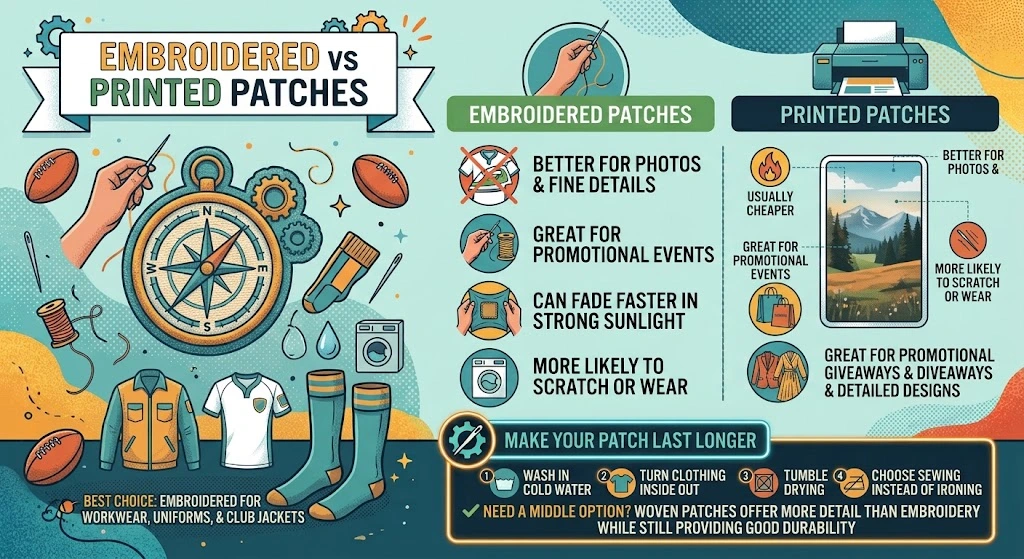
Embroidered patches are what most people picture when they think of a patch. The thread is stitched densely onto a woven base, creating a raised surface you can feel with your fingers. They look traditional, feel premium, and have been the standard for uniforms, clubs, and branded gear for as long as patches have existed.
Order embroidered patches when your design has:
- Bold, clean lines and shapes
- Solid colours with clear separation between them
- Text that is at least 6mm tall
- A look that benefits from a raised, textured finish
Avoid embroidered patches when your design has:
- Gradients or colour blending
- Very small lettering or fine detail under 6mm
- Photographic or painterly elements
Embroidered patches support up to 12 thread colours. Border options include the classic merrowed edge, laser-cut, and stitched borders. Backing options include iron-on heat seal, sew-on, hook and loop, pin, and plastic. Many suppliers set a minimum of 50 pieces, but StitchKrafts Australia has no minimum order.
One thing worth knowing before you order: every embroidered patch needs a digitized stitch file created from your artwork before production can begin. This is what custom digitizing services cover, converting your logo or design into precise stitch instructions the embroidery machine can follow. More on this below.
2. Woven Patches: When the Detail Is Small
Woven patches look similar to embroidered patches at a glance, but the construction is different. Instead of thread stitched on top of a base, the design is woven directly into the fabric using finer thread. The result is flat rather than raised, and because the thread count is higher, woven patches reproduce far more detail in a smaller area.
Order woven patches when your design has:
- Fine lines and intricate detail
- Text smaller than 6mm that embroidery cannot reproduce cleanly
- A modern, flat look rather than traditional raised texture
- Complex logos with multiple small elements close together
Avoid woven patches when your design has:
- Gradients or photography
- A need for raised, tactile texture
Woven patches support up to 10 colours and use the same backing options as embroidered patches. Many suppliers ask for at least 100 pieces, but StitchKrafts Australia has no minimum order.
If your club or business logo has small print that always looks soft or blurry on embroidered patches, woven is almost certainly the right switch.
3. Dye Sublimation Patches: When Colour Is Everything
Dye sublimation patches are the right choice when your design has more going on than embroidery or weaving can handle. The design is embedded directly into a flat twill base using heat and dye, which means the reproduction is essentially photographic. Gradients, shadows, skin tones, and detailed illustrations are all handled with ease.
Order dye sublimation patches when your design has:
- Gradients or colour transitions
- Photographic or painterly artwork
- More than 12 colours
- Very fine detail that needs exact colour accuracy
Avoid dye sublimation patches when:
- You need a raised texture or an embroidered feel
- The flat printed look does not suit the garment or application
Dye sublimation patches support unlimited colours. A source image of at least 300 dpi is required for accurate reproduction. A low-resolution file produces a blurry patch regardless of technique.
Border options include merrowed and laser-cut edges. Backings include iron-on heat seal, hook and loop, and plastic.
4. PVC Patches: Built for the Outdoors
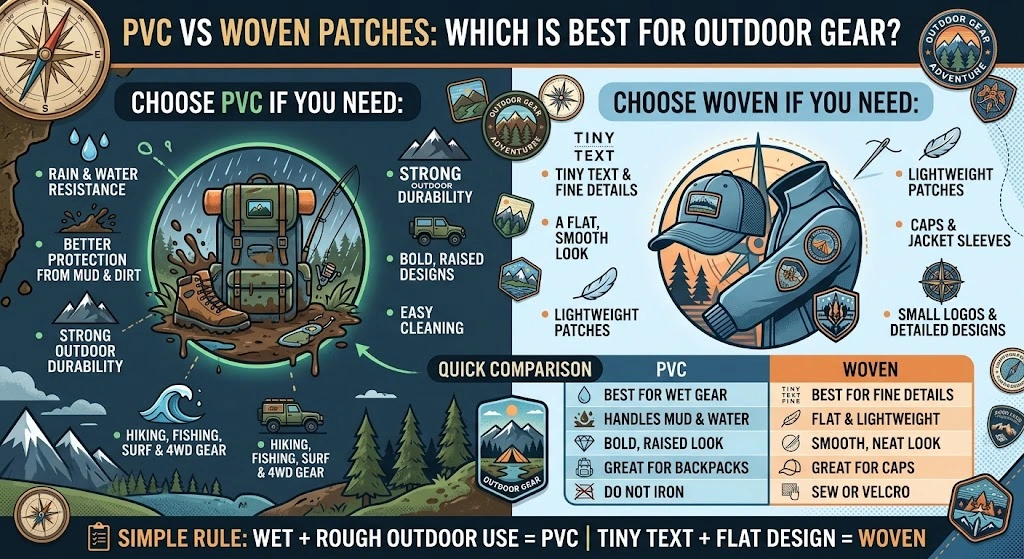
PVC patches are moulded rubber. They are three-dimensional, waterproof, UV-resistant, and built to handle conditions that would destroy fabric patches in weeks. They are the standard choice for outdoor gear, tactical applications, sports bags, and anywhere the patch will be exposed to Australian sun, rain, and physical wear.
Order PVC patches when:
- The patch is going on outdoor, sports, or tactical gear
- Waterproof and UV-resistant construction is needed
- A bold, 3D raised design suits the application
- Hook and loop morale patch or bag attachment is required
Avoid PVC patches when:
- Your design has very fine text or delicate detail, as moulding has minimum line-thickness limits
- The garment calls for a traditional fabric patch look
- You plan to iron the patch on, as PVC patches are not suitable for iron-on application
PVC patch services from quality makers like StitchKrafts Australia produce consistent, clean moulded patches with durable colour that holds up to extended outdoor use.
For hiking packs in the Blue Mountains, footy gear in Queensland, or surf and outdoor brands anywhere across Australia, PVC is the patch that does not quit.
5. Felt Patches: Classic, Soft, and Vintage
Felt patches share the same basic rules as embroidered patches: bold lines, solid colours, and text at least 6mm tall, but deliver a softer, more vintage aesthetic.
The felt base gives the patch a matte, classic quality associated with school uniforms, letterman jackets, scout badges, and heritage branding. If the word vintage fits your project, felt probably fits your patch.
Order felt patches when:
- A vintage, retro, or heritage look is the goal
- The application is school, club, or uniform-related
- Simple artwork with bold fills suits the design
- A softer, matte finish suits the garment better than raised embroidery
Avoid felt patches when:
- Fine detail, small text, or gradients are part of the design
- Outdoor or heavy-wear durability is required
Felt patches support up to 12 thread colours and use the same border and backing options as embroidered patches. Many suppliers set a minimum of 50 pieces, but StitchKrafts Australia has no minimum order.
6. Combination Patches: When One Technique Is Not Enough
Combination patches blend two methods into one. Typically, a sublimated background features gradients, photographs, or complex imagery, while embroidery is layered on top to create raised, textured elements.
The result is genuine depth: a photographic background with a bold logo or text sitting above it in raised thread.
Order combination patches when:
- Your design has a complex background and bold foreground elements
- You need the details of sublimation and the texture of embroidery together
- Visual impact matters, and a single-technique patch does not do the design justice
Combination patches support unlimited colours due to the sublimation component, and all standard border and backing options apply.
The Simple Decision Table
| Features | |
| Bold logo, thick lines, solid colours | Embroidered |
| Fine lines, small text under 6mm | Woven |
| Gradients, photos, or many colours | Dye Sublimation |
| Outdoor, waterproof, or tactical use | PVC |
| Vintage or heritage aesthetic | Felt |
| Complex background plus raised detail | Combination |
What Are Custom Digitizing Services and Do You Need Them?
If you are ordering embroidered or woven patches, yes, you need custom digitizing services, whether you know it or not.
Digitizing converts your artwork, logo, illustration, or text into a stitch file that tells the embroidery machine exactly how to reproduce your design. Stitch direction, density, colour order, underlay, and other technical details are all specified in the digitized file.
A good digitized file produces crisp, accurate patches. A bad one produces patches that look nothing like the original artwork, regardless of how good the design itself is.
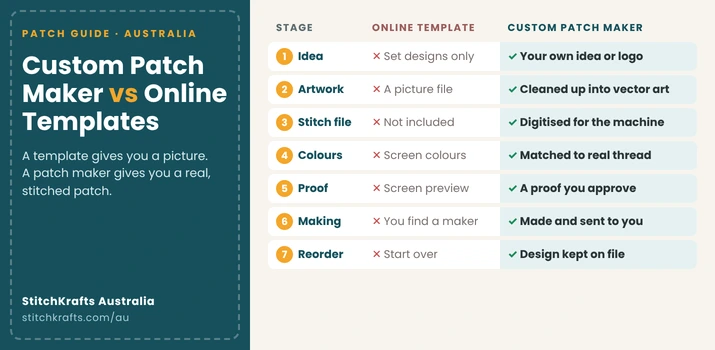
When you order custom made patches from a quality supplier, digitizing is handled as part of the process. StitchKrafts Australia includes custom digitizing services with patch orders and provides a physical sample for approval before full production begins, so you see the actual finished patch, not just a digital mockup, before committing to the full run.
If you are a small business, sports club, or school in Australia ordering for the first time, this sample stage is the one thing worth asking about specifically. It saves reprints, delays, and disappointment.
Ironing a Patch on a Hat: Match the Type First
For the full step-by-step method, read our guide on how to sew a patch on a hat without ruining it.If you plan to iron a patch on a hat, the patch type determines whether it is even possible.
Embroidered and woven patches with iron-on heat-seal backing work well on cotton caps when applied correctly. Use maximum heat, no steam, a circular pressing motion, and pay particular attention to the edges.
PVC patches cannot be ironed on and should use hook-and-loop or sew-on backing on headwear.
Felt patches can be ironed onto cotton hats but need slightly lower heat and shorter press times than embroidered patches.
Getting the backing type right when you order is far easier than trying to fix a mismatch once the patches arrive.
Related Guides
- Embroidered vs woven patches: the key differences
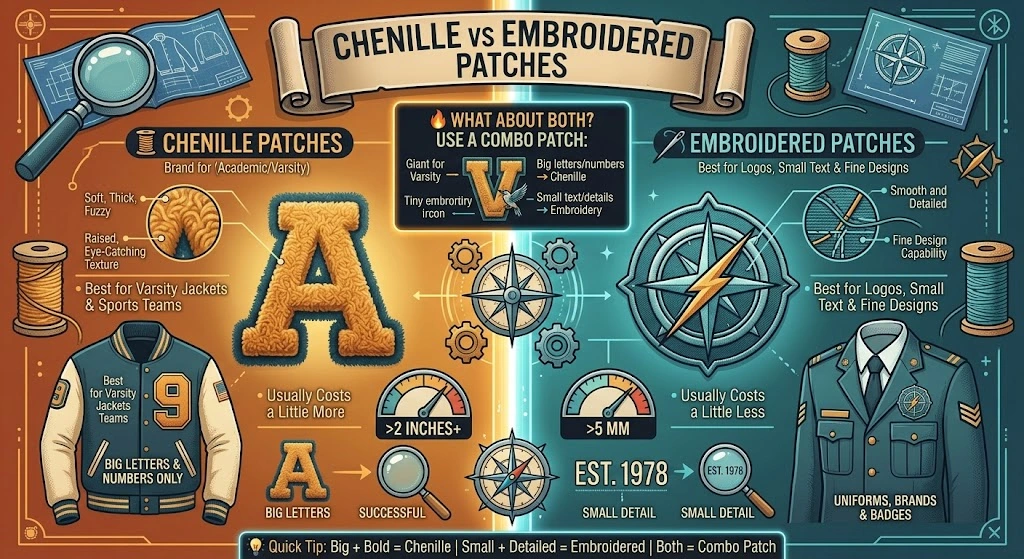
- Chenille vs embroidered patches
- PVC vs woven patches for outdoor gear
- Best patch material for backpacks
Frequently Asked Questions
What is the difference between embroidered and woven patches?
Embroidered patches have raised thread stitched onto a woven base and suit bold, simple designs with solid colours. Woven patches are flat, have a finer thread count, and suit intricate designs with small text and fine detail.
Both use similar backings and borders. The design complexity is what determines which to choose.
What custom made patch type is best for a design with gradients?
Dye sublimation patches. Embroidered and woven patches cannot reproduce gradients or colour blending effectively. Sublimation handles unlimited colours and photographic detail with exact accuracy.
What are PVC patches best used for in Australia?
Outdoor gear, sports bags, tactical equipment, and any application where the patch will be exposed to weather, UV, or physical wear. PVC patches are waterproof and UV-resistant, making them well suited to Australian outdoor and sports applications where fabric patches degrade quickly.
Do I need custom digitizing services to order embroidered patches?
Yes. Every embroidered patch requires a digitized stitch file prepared from your artwork before production. Quality suppliers include this in the order process.
Always ask whether a physical sample is provided before the full production run.
What is the minimum order for custom-made patches in Australia?
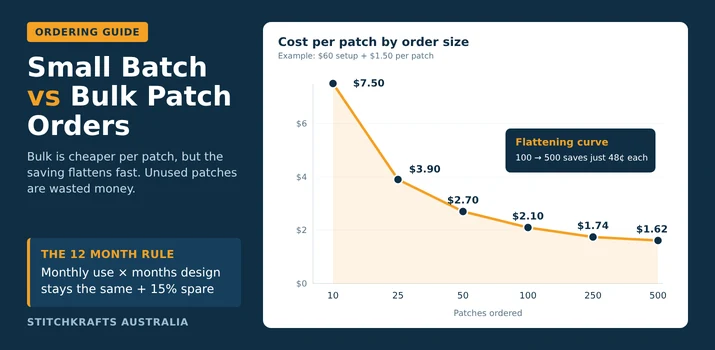
Many suppliers set minimums of 50 pieces for embroidered and felt patches and 100 for woven and sublimated patches. StitchKrafts Australia has no minimum order, so you can order a single patch or several thousand at the same quality.
Confirm minimums with your supplier before finalising your design choice.
Can I iron any patch type onto a hat?
No. Embroidered and woven patches with iron-on backing work on cotton caps. PVC patches must be sewn or hook-and-loop attached and should never be ironed. Felt patches can be ironed onto cotton hats with care.
Always confirm the backing type when ordering if the hat application is the plan.