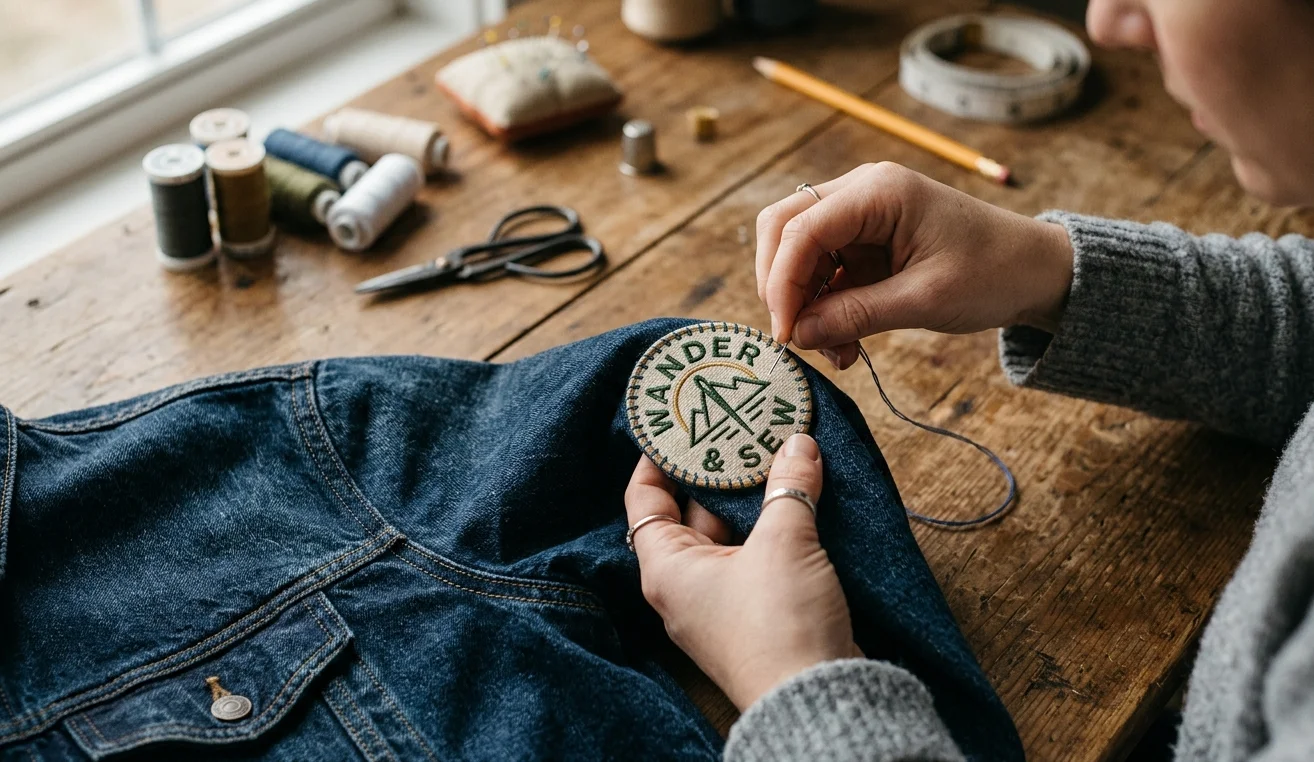
How to Sew a Patch on a Sleeve Perfectly
Simple steps. No experience needed. Works on jerseys, hoodies, and jackets.
Quick Answer
Wash the shirt first. Iron the sleeve flat. Pin the patch in place and try the shirt on to check how it looks with your arm inside. Then sew all the way around the edge of the patch from inside the sleeve so you never stitch it shut. Tie off the thread and trim. The whole job takes about 15 to 20 minutes.
Why Sleeves Are Harder Than the Rest of the Shirt
Most people successfully patch a jacket front or a bag without much trouble. Then they try a sleeve and things go wrong.
The reason is simple. A sleeve is a tube of fabric, not a flat panel. It curves around your arm. It moves every time you bend your elbow. On stretchy knit jerseys it shifts even more. A patch that looks perfectly placed when the sleeve is lying flat on a table can look completely crooked once your arm is inside it.
The fix is easy once you know it. This guide shows you exactly what to do, step by step, in plain language.
Whether you are sewing a club badge onto a footy jumper, adding a school crest to a hoodie, putting a custom embroidered patch from StitchKrafts Australia on a work shirt, or decorating any sleeved garment at all, this method works every time.
What You Need
You do not need a sewing machine. You do not need any sewing experience. Here is everything that makes the job easier:
| Item | |
| Sewing needle | Stitching the patch by hand |
| Thread, about 45 to 50 cm | Going around the patch edge |
| Safety pin or adhesive ironing tape | Holding the patch still before you sew |
| Scissors | Cutting the thread when done |
| Iron and cotton cloth | Pressing the sleeve flat before you start |
| Needle threading tool | Optional but very helpful |
All of these are available at any craft store, fabric shop, or general merchandise store near you.
Before You Start
Wash the Shirt First
Always wash the shirt before sewing a patch on. New garments can have fabric softener or factory treatments on them. These create a barrier that stops adhesive from gripping and makes the fabric harder to sew neatly. Wash it, dry it, and then start.
Iron the Sleeve Flat
Lay the sleeve flat and iron it smooth. Place a thin cotton cloth between the iron and the jersey fabric to protect it, especially if the material is synthetic or stretchy. A flat sleeve is much easier to work on than a creased one.
Step 1. Decide Where the Patch Goes
Hold the patch against the sleeve and look at a few different positions before deciding.
If you are putting a patch on a sports jersey, your team or organisation may have a specific rule about placement. Some teams require patches a set distance below the shoulder seam. Always check these rules before placing anything permanently.
For personal projects, go with what looks right to you.
Standard Sleeve Placement for Uniforms and Team Kit
If you have no rules to follow, these measurements give a clean, professional look on almost any shirt, jumper or jacket:
- Centre the patch on the outer side of the upper sleeve, in line with the middle of the arm.
- Place the top edge about 5 cm below the shoulder seam. On a raglan sleeve with no shoulder seam, measure about 5 cm down from the neckline seam instead.
- Keep sleeve patches to around 7 to 9 cm wide on adult garments and 5 to 7 cm on kids sizes. Bigger patches wrap around the arm and look tilted.
- If you are patching both sleeves, measure each side the same way so they sit at matching heights.
For a whole team or school, make a simple cardboard template with the measurements marked on it. Everyone then gets the same placement, even if different parents or volunteers are doing the sewing.
Step 2. Pin the Patch and Try the Shirt On
This step is the one most people skip. It is the most important step in the whole guide.
Pin the patch in place with a safety pin through the centre. Then put the shirt on. Look at the patch with your arm naturally inside the sleeve.
A sleeve curves around your arm. A patch that sits straight when the sleeve is flat on a table can look tilted or off-centre once your arm is filling the fabric. You need to see it on your body to know for certain.
If it looks good, take the shirt off and move to the next step. If it looks crooked, adjust the pin and try again.
Step 3. Secure the Patch in Place
Now you need the patch held firmly while you sew.
You have two options.
The first option is to leave the safety pin in place. It works but the pin can get in the way of your needle as you sew around the edge of the patch.
The second option is adhesive ironing tape. Cut small strips and place them just under the edges of the patch. Lay the sleeve flat, put the cotton cloth over the patch, and press with a warm iron for a few seconds. The tape tacks the patch down lightly without making it permanent. It holds everything still while you sew and there is nothing in your way.
Step 4. Slide Your Hand Inside the Sleeve
Before you pick up the needle, do this one thing.
Slide one hand inside the sleeve so it sits behind the patch. This does two things. It supports the fabric while you push the needle through, and it makes sure you only stitch through the outer layer of the sleeve. If you sew without your hand inside, it is very easy to accidentally sew through both sides of the sleeve and stitch it shut. This is the most common sleeve patching mistake and it is completely avoidable.
Step 5. Thread the Needle
Cut about 45 to 50 cm of thread. If you have a needle threading tool, use it. If not, wet the tip of the thread slightly and twist it to a point before pushing it through the eye of the needle.
Tie a knot at one end of the thread. You are now ready to sew.
Step 6. Start the First Stitch
Start from inside the sleeve so the knot sits hidden on the inside of the fabric.
Push the needle upward from the inside, through the sleeve fabric, and out through the very edge of the patch. Pull the thread all the way through until the knot catches against the inside of the sleeve.
This is your anchor. Everything starts from here.
Step 7. Sew All the Way Around
Now continue stitching around the full edge of the patch. The motion is the same for every stitch.
Push the needle down through the sleeve fabric right next to the edge of the patch. Pull the thread through to the inside. Then push the needle back up through the sleeve fabric and out through the patch edge again. Pull firm after every stitch.
Keep your stitches about 3 to 5 millimetres apart. Even spacing makes the finished result look clean and intentional. Uneven spacing looks rushed.
Keep checking that your hand inside the sleeve is not getting caught by the needle. The goal is to feel the needle tip from the inside so you can control where it goes without stabbing yourself.
Work all the way around the patch until you are back where you started.
Step 8. Tie Off and Trim
For your final stitch, bring the thread through to the inside of the sleeve. Tie a firm knot close to the fabric. Tie it two or three times to make sure it will not loosen over time. Trim the leftover thread to about 1 cm from the knot.
Remove the safety pin if you used one.
Turn the sleeve over and look at the patch from the outside. The stitching should sit evenly around the full border. The patch should lie completely flat with no puckering or gathering in the sleeve fabric around it.
Using a Sewing Machine on a Sleeve
A sewing machine is faster but it has one major risk on a sleeve. If you do not set up correctly, you will sew the sleeve shut.
To avoid this, slide the sleeve over the sewing machine arm or platform so the top layer of fabric is sitting directly under the needle and the bottom layer is hanging free below. Never let both layers sit stacked on top of each other under the presser foot.
Once you have the sleeve positioned correctly:
Set the machine to a slow straight stitch. Lower the presser foot. Sew along the edge of the patch all the way around. On a circular patch, rotate it gradually as the stitches build. On a square or rectangular patch, stop at each corner, raise the presser foot, rotate 90 degrees, lower the presser foot, and continue. When you reach the starting point, overlap the first few stitches to lock the seam and use the reverse function for a few backward stitches to finish.
One important note. Machine sewing works well on woven fabric and thick hoodies. For stretchy knit cotton jerseys, hand sewing gives better results. The machine's feed system can cause knit fabric to pucker and stretch unevenly, which leads to a puckered patch even if the stitching itself is neat.
How to Stop Iron-On Patches From Falling Off a Sleeve
A sleeve is the hardest place on any garment for an iron-on patch to hold. Every time you move your arm, the fabric flexes. Every time you wash the shirt, the adhesive weakens a little. On a sleeve specifically, iron-on alone rarely lasts more than a few months of regular use.
Here is how to make sure your patch stays on permanently.
Sew After Ironing
This is the single most effective thing you can do. Iron the patch first to position it precisely. Then sew around the border. This combination holds through years of wear and washing regardless of the fabric type. It is the professional standard for jersey patches in sports teams across the country.
Check the Fabric Before You Iron
Iron-on adhesive bonds to cotton and cotton blend fabrics reliably. It does not bond well to polyester performance fabrics, moisture-wicking sportswear, or nylon. If your jersey is made from synthetic material, skip the iron entirely and go straight to sewing.
Give It 24 Hours Before Washing
After ironing a patch, the adhesive needs time to fully cure and harden. Washing the shirt within hours of application puts stress on the bond before it has fully set. This is one of the most common reasons patches start lifting at the edges after just one or two washes. Wait at least a full day.
Start With a Quality Patch
Cheap patches use thin adhesive applied unevenly across the backing. The centre may bond but the edges, which are under the most movement stress on a sleeve, lift quickly. Custom embroidered patches from StitchKrafts are made with full coverage adhesive across the entire backing, which means the bond holds from edge to edge and the patch has a solid foundation before a single stitch goes in.
If you are ordering patches for a team, school or club, custom embroidered patches with a merrowed border are the easiest to sew neatly on a sleeve, and woven patches are thinner and more flexible on light jerseys.
Fabric Types and Which Method Works Best
| Fabric Type | ||
| Woven jersey | Hand or machine | Stable and easy to work with |
| Knit cotton jersey | Hand sewing | Stretches too much for clean machine stitching |
| Polyester sportswear | Hand sewing only, no iron | Synthetic fabric does not hold iron-on adhesive |
| Heavy cotton hoodie | Hand or machine | Thick enough to handle both methods |
| Moisture-wicking fabric | Hand sewing only | Always sew, never iron on these materials |
Mistakes That Ruin Sleeve Patches
These are the mistakes that show up most often and are the easiest to avoid.
Not Trying the Shirt On First
Always check the placement with your arm inside the sleeve before sewing. Flat-on-a-table placement and on-the-body placement look completely different on a curved sleeve.
Forgetting to Put Your Hand Inside the Sleeve
Without your hand inside, it is easy to accidentally sew through both layers and stitch the sleeve shut. This wastes time and can damage the shirt.
Pulling Stitches Too Tight
Firm and flat is correct. Pulling too tight bunches the sleeve fabric around the patch and leaves permanent puckers that no amount of ironing will fix.
Rushing the Iron-On Step
If your patch has iron-on backing, use maximum heat, no steam, and press for a full 60 seconds. A short press that does not fully activate the adhesive produces a bond that looks fine at first but peels within days.
Washing Too Soon After Ironing
Give the adhesive 24 hours to cure before the first wash.
Related Guides
- How to iron on patches without ruining your clothes
- How to wash clothes with iron-on patches
- How to remove a sew-on patch
- How to sew a patch on a hat
Frequently Asked Questions
Why does my patch look crooked after I sew it on?
The most likely reason is that you placed and sewed the patch with the sleeve lying flat. A sleeve curves around your arm, so what looks straight on a flat surface can look crooked when worn. Always try the shirt on with the patch pinned in place before sewing.
Can I sew a patch on a sleeve without a sewing machine?
Yes. Hand sewing is actually the better method for most jersey and knit fabrics. All you need is a needle, thread, and about 20 minutes. The result is just as strong as machine stitching and easier to control on curved or stretchy fabric.
How do I stop the sleeve from getting stitched shut while I sew?
Slide your hand inside the sleeve before you start. This separates the two layers of fabric and lets you feel exactly where the needle is going. For machine sewing, slide the sleeve over the machine arm so only the outer layer sits under the needle.
How do I keep iron-on patches from falling off a sleeve?
Sew around the border after ironing. Sleeves flex more than any other part of a garment, which puts the iron-on bond under constant stress. Sewing the edge after ironing gives a permanent hold that adhesive alone cannot match on a moving sleeve.
How long does it take to sew a patch on a sleeve by hand?
Between 15 and 25 minutes depending on the size of the patch and how quickly you stitch. The preparation steps take just as long as the sewing itself. Do not rush the placement check and you will not have to redo the work.
Does patch quality affect how long it stays on?
Significantly. A patch with full, even adhesive coverage across the entire backing bonds more cleanly and holds longer from the start. StitchKrafts Australia produces custom embroidered patches with consistent full-coverage backing, which means the bond holds edge to edge rather than just in the centre where pressure is most concentrated during ironing.
The One Rule That Covers Everything
Slide your hand inside the sleeve before you pick up the needle. This single step prevents the most common sleeve patching mistake, keeps the stitching on the outer layer only, and gives you control over every stitch from start to finish.
Everything else in this guide makes the result better. This one step makes the result possible.