Attaching Patches to a Poppy Appeal Collection Tin or Jacket
Quick answer: Ask your local Poppy Appeal organiser before attaching anything to an official collection tin, and never cover its seal, number, or charity details. For jackets and tabards, sew a patch on, or use Velcro if you want to take it off afterwards. Keep patches off reflective strips, and check the Royal British Legion's guidance before putting the poppy emblem on anything you make.
Remembrance is a quiet, respectful time. Volunteers and veterans groups often want to look smart and be easy to spot, and a neat badge can help. This guide covers what is sensible to do, and what to check first, so your collection day goes smoothly.
A Note on Timing
Remembrance Sunday is on 8 November, and Armistice Day is on Wednesday 11 November. That is only days away. A custom patch order is unlikely to arrive in time for this year.
So for this year, use what you already have. A plain jacket, a tidy tabard, and the official poppy items are all you need. If you would like a patch for next year's appeal, or for a parade, a branch jacket, or a veterans' group, the best time to plan is early in the year.
First Rule: Ask Before You Attach Anything to a Tin
Collection tins are issued by the charity. They have a sealed lid, and they usually show a serial number and the charity's name and number. These details are there for good reasons. They keep the money safe, and they show the public that the collection is genuine.
Because of that, please do not add a patch, a sticker, or anything else to an official tin without asking your local organiser first. They know the rules for your area, and they will tell you what is allowed.
If they say yes, follow these rules:
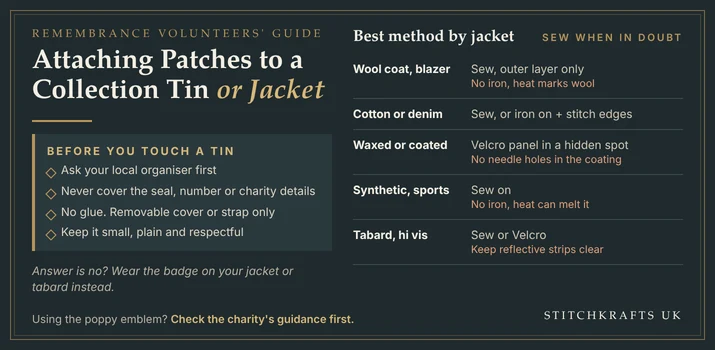
- Never cover the seal, the serial number, or the charity details.
- Never glue anything straight onto the tin. It can leave marks, and it can make the tin look tampered with.
- Use something removable, like a fabric cover or a strap that slips on and off.
- Keep it small and plain. A simple, respectful design looks best.
If the answer is no, that is fine. A tin does not need decoration. Put your badge on your jacket or tabard instead, where it can be seen clearly.
Attaching a Patch to a Jacket
For a coat or jacket, a sewn on patch is the neatest and strongest option. Here is how to get a clean result.

- Pick the right spot. Many people wear a poppy on the left, over the heart. Keep your patch clear of it, so the two do not crowd each other. Check any uniform or branch rules first.
- Pin or clip it in place. Lay the jacket flat, and check the patch looks straight from a few steps back.
- Sew it on. Use strong thread in a colour that matches the border. Sew small, even stitches all the way round, about 3 to 5 millimetres apart. Add two or three extra stitches at each corner. Tie off on the inside.
- Check the lining. On a coat or blazer, sew only through the outer fabric where you can. Sewing through both layers can make the lining pucker.
Take your time. A neat patch looks respectful, and a crooked one is easy to spot.
Different Jackets Need Different Methods
Not every jacket takes a patch the same way. Here is a quick guide.
| Jacket Type | Best Way to Attach | What to Avoid |
|---|---|---|
| Wool coat or blazer | Sew on, small stitches, outer layer only | Iron on, since heat can mark wool |
| Cotton or denim jacket | Sew on, or iron on and stitch the edges | Skipping the corner stitches |
| Waxed or coated jacket | Velcro panel sewn to a hidden spot, or ask a tailor | Sewing through the coating, since the needle holes can let water in |
| Synthetic or sports jacket | Sew on | Iron on, since heat can melt the fabric |
| Leather jacket | Sew on, using clips instead of pins | Iron on, since heat can scorch leather |
If you are unsure what your jacket is made from, check the label inside. When in doubt, sewing is the safest choice.
Tabards and Hi Vis Vests
Many collectors wear a tabard or hi vis vest, so they are easy to find in a crowd. A few simple rules help.
Do not put a patch over the reflective strips. Those bands help drivers and passers by see you, especially at dusk, and covering them defeats the point.
Sew the patch on, or use Velcro. Do not iron on a synthetic vest, because the heat can melt it.
If the tabard is supplied by the charity or your branch, ask before you add anything to it. It may need to stay as it is.
Want to Take It Off Afterwards? Use Velcro
If you only want a badge for one event, a Velcro patch is a good choice. Sew the soft side onto the jacket, and put the rough side on the back of the patch. You can then peel it off and keep it safe.
Velcro also works well if several volunteers share the same jacket or tabard. Each person can put their own badge on and take it off at the end of the day.
Keeping It Safe
A few small points keep the day safe and tidy.
Make sure every edge is firmly attached, so nothing flaps or catches. Keep patches clear of buttons, zips, and pockets you use a lot. Do not put anything on the tin that could come loose and get lost. And if you hand a tin to anyone else, check that it still looks exactly as it should.
Using the Poppy Emblem: Check First
This is the most important point if you are making your own patches.
The poppy and the Poppy Appeal name are closely linked to the Royal British Legion, and there are guidelines about how they can be used. Before you put the poppy emblem, or the words "Poppy Appeal," on anything you make, read the charity's guidance, or contact them directly. This matters even more if you plan to sell the items.
An easy way to avoid trouble is to design your patch around your own group or branch instead. A simple badge with your group's name, crest, or colours is always safe, and it keeps the focus on your own members.
Choosing a Patch for a Parade or Branch Jacket
If you are planning a badge for a veterans' group, a branch, or a cadet unit, a classic embroidered patch is a good fit. The stitched thread looks smart, holds up through years of wear, and suits formal jackets and blazers. Keep the design simple and dignified, with clear words and a limited number of colours.
Common Mistakes to Avoid
Attaching anything to an official tin without asking. Covering the seal or serial number. Gluing a patch straight onto a tin. Ironing a patch onto wool or synthetic fabric. Covering reflective strips on a tabard. Using the poppy emblem on your own patch without checking the rules. And leaving it too late, since a custom order needs time.
Frequently Asked Questions
Can I put a patch on a Poppy Appeal collection tin?
Ask your local organiser first. Never cover the seal, the serial number, or the charity details, and never glue anything straight onto the tin.
How do I attach a patch to a jacket for Remembrance?
Sew it on with small, even stitches, and add a few extra stitches at each corner. Use Velcro if you want to take it off afterwards.
Can I iron a patch onto a wool coat?
It is best not to. Heat can mark wool, so sewing is safer.
Where should I put a patch if I am wearing a poppy?
Many people wear the poppy on the left, over the heart. Put your patch clear of it, and check any uniform or branch rules.
Can I make patches with a poppy on them?
Check the Royal British Legion's guidance first, especially if you plan to sell them. A badge with your own group's name or crest is a simple, safe choice.
Is it too late to order a patch for Remembrance Sunday?
For 8 November, yes, it is very unlikely a custom order will arrive in time. Plan early for next year.
Planning a Badge for Next Year?
If your branch, group, or unit would like a smart badge for next year, our custom patches can be made in your own design, size, and colours. StitchKrafts UK works with clubs, associations, and community groups in Birmingham and across the UK, and we are happy to talk through what is possible well before you need it.