How to Pick the Perfect Patch Type for Your Custom-Made Patches
Get this right before you order. This guide shows you how to match your design to the correct patch type, the first time.
The Mistake That Ruins Most First Orders
Somebody designs a logo. They send it off for custom made patches. Three weeks later, the patches arrive. The small text is unreadable. Or the gradient background has turned into one flat block of colour. Or the patch they ordered for a waterproof jacket has already started peeling after one walk in the rain.
This is not bad luck. It happens because the design did not match the patch type.
Every patch-making method has different strengths. Pick the wrong one, and even a great design looks average, or fails completely in the job it was meant for. Pick the right one and the patch looks exactly as planned and lasts a long time.
This guide explains every common patch type in plain words. You can use it to match your design correctly before you order, whether you are ordering for a business in Manchester, a club in Bristol, or a personal project anywhere in the UK.
Quick Answer
- Bold logo with solid colours? Choose embroidered.
- Small text or fine detail? Choose woven.
- Gradients, photos, or lots of colours? Choose dye sublimation.
- Outdoor or wet weather use? Choose PVC.
- A classic or heritage look? Choose felt.
- A complex design that needs both texture and fine detail? Choose a combination patch.
Embroidered Patches. The One Most People Picture
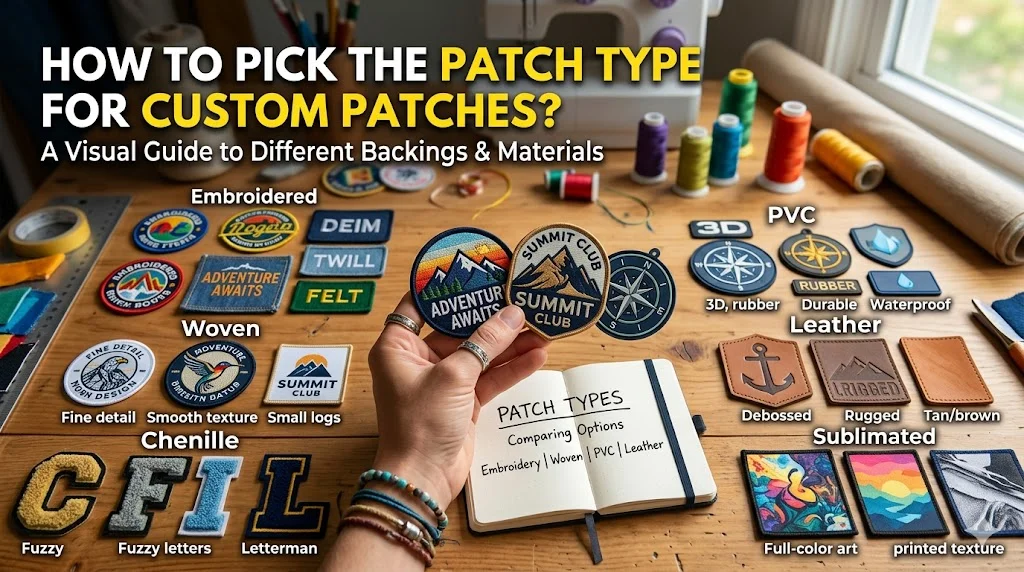
When people imagine a patch, they usually picture this one. Thick thread is stitched onto a woven base. This creates a raised surface you can feel with your fingers. It is the traditional style used on uniforms, scout badges, motorcycle jackets, and work clothing for many years.
Choose embroidered patches when your design has:
- Bold, simple shapes with clean lines.
- Solid colours with clear gaps between each one.
- Lettering that is at least 6mm tall.
- A look that suits a raised, textured finish.
Avoid embroidered patches when your design has:
- Gradients or blended colours.
- Fine detail or text smaller than 6mm.
- A photo style or painted look.
Embroidered patches can use up to 12 thread colours. You can pick a merrowed border (the classic raised edge), a laser cut edge for unusual shapes, or a stitched border. Backing choices include iron on heat seal, sew on, hook and loop, pin, and plastic. Most suppliers set a minimum order of around 50 patches.
One thing catches many first-time buyers out. Every embroidered patch needs to be digitised before it can be stitched. We explain this further down.
Woven Patches. For Designs Too Detailed for Thread
Woven patches look a bit like embroidered patches at first glance, but they are made differently. Instead of the thread sitting on top of a base, the design is woven directly into the fabric using a much finer thread. This gives a flat finish instead of a raised one, and it allows for far more detail in a small space.
Choose woven patches when your design has:
- Fine lines or detailed shapes.
- Small text under 6mm that embroidery would make blurry.
- A flat, modern look rather than a raised one.
- Several small parts placed close together.
Avoid woven patches when your design has:
- Gradients or photo style images.
- A need for the raised, textured feel that embroidery gives.
Woven patches can use up to 10 colours and use the same backing choices as embroidered patches. Minimum orders are usually around 100 patches. If a club crest or logo always looks a bit soft on an embroidered patch, switching to woven often fixes this.
Dye Sublimation Patches. For Anything With Colour Depth
Dye sublimation patches handle things embroidery and weaving cannot. This includes gradients, shading, photo level detail, and large colour ranges. The process places dye directly into a flat fabric base using heat. The result looks more like a print than a traditional patch.
Choose dye sublimation patches when your design has:
- Gradients or smooth colour changes.
- Photo style or painted images.
- More than 12 colours.
- Fine detail that needs exact colour matching.
Avoid dye sublimation patches when:
- You want a raised, traditional embroidered look.
- A flat printed style does not suit the item.
Dye sublimation patches allow unlimited colours. You will need to send artwork at a minimum of 300 dpi. Anything lower will come out blurry, no matter how good the printing method is. Border choices are merrowed and laser cut. Backing choices include iron on heat seal, hook and loop, and plastic.
PVC Patches. Made for British Weather
PVC patches are made from moulded rubber instead of fabric. They are waterproof, resist sun damage, and hold up well over time. This makes them a strong choice for anything that spends time outdoors in typical British weather, including rain and the occasional bit of sunshine.
Choose PVC patches when:
- The patch is going on outdoor gear, backpacks, or tactical kit.
- You need something waterproof and weather resistant.
- A bold, 3D moulded design fits the look you want.
- You want hook-and-loop backing so patches can be swapped easily on bags.
Avoid PVC patches when:
- Your design has very fine lines. The moulding process has a limit on line thickness.
- A soft fabric look and feel fits the project better.
- You were planning to iron it on. PVC patches cannot be ironed. They need sewing or hook and loop instead.
PVC patch services from a trusted maker like StitchKrafts UK give you consistent moulding, sharp colours, and a finish built to last through years of wet weather use. This makes them a good fit for hiking groups, outdoor brands, and anyone preparing gear for places like the Lake District or the Scottish Highlands.
Felt Patches. A Softer, More Classic Look
Felt patches follow similar rules to embroidered patches. Bold shapes, solid colours, and text that is at least 6mm tall. But they give a softer, matte finish instead. This is the look used for letterman jackets, school badges, and heritage branding. If your project has a vintage feel, felt is usually the better choice.
Choose felt patches when:
- You want a retro or heritage look.
- The patch is for a school, club, or uniform.
- Your design is simple and bold.
- A matte finish suits the item better than a raised embroidered look.
Avoid felt patches when:
- Fine detail, small text, or gradients are part of the design.
- The patch needs to survive heavy outdoor use.
Felt patches can use up to 12 thread colours and use the same border and backing choices as embroidered patches. Minimum orders usually start around 50.
Combination Patches. Two Methods, One Patch
Combination patches mix sublimation and embroidery together in one patch. A sublimated background holds the gradients, photo detail, or complex images. Embroidered parts sit raised on top of this, usually for text or a logo. This gives real depth that neither method achieves alone.
Choose a combination patch when:
- Your design has a detailed background plus a bold raised element.
- You want the colour range of sublimation and the texture of embroidery together.
- You need a patch with strong visual impact for branding.
Combination patches allow unlimited colours because of the sublimation part. All the usual border and backing choices apply.
Quick Decision Table
| Your Design Has | |
| Bold logo, solid colours | Embroidered |
| Small text, fine lines | Woven |
| Gradients, photos, many colours | Dye sublimation |
| Outdoor or wet weather use | PVC |
| Vintage or heritage look | Felt |
| Complex background plus raised detail | Combination |
Custom Digitizing Services. Why You Need Them, Even If You Did Not Know It
If you order embroidered or woven patches, your design must go through a process called digitising before any stitching happens.
Digitising turns your artwork, such as a logo, crest, or piece of text, into a stitch file the embroidery machine follows exactly. It controls stitch direction, thread density, colour order, and the support layer underneath. Done well, this file produces a patch that matches your original design closely. Done badly, the patch comes out distorted no matter how good the original art was.
A good supplier includes digitising as a normal part of the order and gives you a physical sample before making the full batch. StitchKrafts UK includes custom digitizing services with every embroidered and woven order and sends a real sample, not just a digital picture, so you can see the true result before agreeing to the full quantity.
This sample step is worth asking about clearly if you are ordering custom made patches for the first time. It is the one thing that stops you wasting a full production run.
Ironing a Patch on a Hat? The Patch Type Decides If You Can
If your plan is to iron a patch onto a cap or hat, the patch type you chose earlier decides whether this is even possible.
Embroidered and woven patches with iron-on heat-seal backing work well on cotton caps. Use maximum heat, no steam, and a circular pressing motion, with extra time spent on the edges. Felt patches can also be ironed onto cotton hats, but they need slightly lower heat and a shorter press time. PVC patches cannot be ironed at all. They always need sewing or hook-and-loop attachment, no matter the item.
Choosing the right backing type when you order saves a lot of trouble later, especially if you plan to apply patches to hats.
Frequently Asked Questions
What is the difference between embroidered and woven patches?
Embroidered patches use raised thread stitched onto a woven base and suit bold, simple designs with solid colour blocks. Woven patches are flat with a finer thread and suit detailed designs with small text. Both use similar backing and border choices. The amount of detail in your design decides which one fits best.
Which patch type is best for a logo with gradients?
Dye sublimation. Neither embroidered nor woven patches can show gradients or smoothly blended colours. Sublimation can handle unlimited colours and detailed shading clearly.
Are PVC patches good for wet British weather?
Yes. That is exactly what they are made for. PVC patches are waterproof and resist sun damage, which makes them a smart choice for outdoor gear, backpacks, and anything regularly exposed to rain.
Do I need custom digitizing services for embroidered patches?
Yes. Every embroidered or woven patch needs a digitised stitch file made from your artwork before production starts. Check with your supplier that this is included and that you will see a physical sample before the full order is made.
What is the usual minimum order for custom-made patches?
It depends on the type. Embroidered and felt patches usually start around 50 pieces. Woven and dye sublimation patches usually start around 100 pieces. Always check the exact number with your chosen supplier.
Can any patch type be ironed onto a hat?
No. Embroidered and woven patches with iron-on backing work well on cotton caps. Felt patches can be ironed with slightly less heat. PVC patches always need sewing or hook and loop. They should never be ironed.