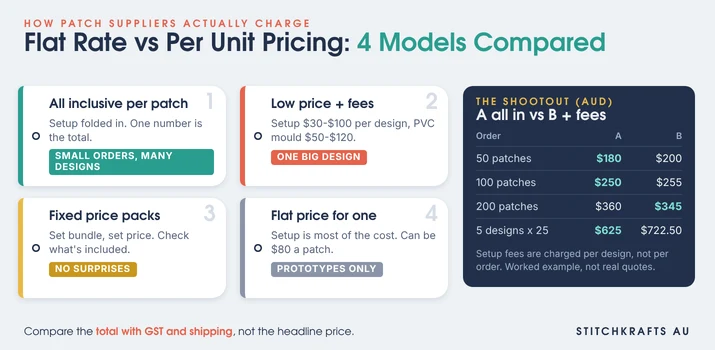
Flat Rate vs Per Unit Pricing: How Patch Suppliers Actually Charge
Quick answer: Patch suppliers charge in four main ways: a price per patch that drops with quantity, a price per patch plus separate fees, fixed price packs, and a flat price for very small orders. None is always cheapest. All inclusive pricing wins on small orders and many designs. A low price per patch with setup fees can win on one big order of a single design. Always compare the total, not the headline price.
If you have ever collected three patch quotes and found three completely different layouts, you are not imagining it. Suppliers build their prices in different ways. This guide explains each model in plain English, then runs the same orders through them so you can see who wins.
Why Quotes Look So Different
Making patches has two kinds of cost. One is the cost of each patch: thread, fabric, and machine time. The other is a one off job: turning your design into stitches and getting the machine ready. That one off job costs about the same whether you make 20 patches or 200.
Suppliers handle that one off cost in different ways. Some hide it inside the price of each patch. Some show it as a separate fee. Some bundle everything into a set price. That is why two quotes can look so different, even when the real cost is similar.
The Four Pricing Models
Model 1: All Inclusive Price Per Patch
The setup cost is folded into the price of each patch. You see one number, and that number is the total.
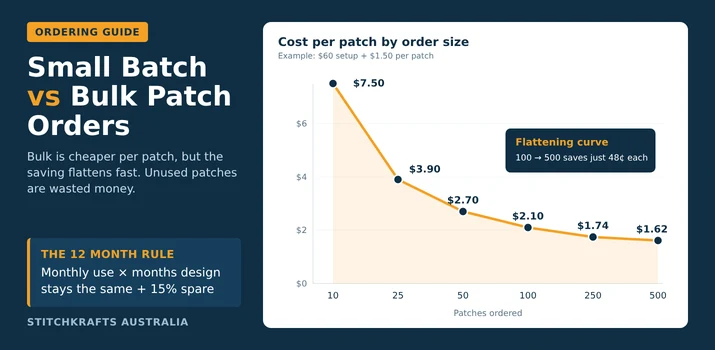
Because the setup cost is spread across fewer patches, small orders cost more per patch, and the price drops as the quantity grows. Some suppliers also include shipping, proofs, and artwork in this number.
Good for: buyers who want a simple, clear total, and anyone ordering small batches or several designs.
Model 2: Low Price Per Patch Plus Separate Fees
The price per patch looks low, but there are extra lines on the quote. These can include a setup fee or digitizing fee per design, a proof fee, a mould fee for PVC patches, shipping, and charges for backing or extra colours.
Published market figures put setup and digitizing at roughly $30 to $100 per design, and a PVC mould at roughly $50 to $120. Fees like these can turn an advertised $1 patch into something closer to $3 or $5 at checkout on a small order.
Good for: one large order of a single design, where the setup fee is shared by many patches.
Model 3: Fixed Price Packs
The supplier sells a bundle at a set price, such as 50 patches for a single fixed amount. You pick a pack, and the price is the price. There is no calculator and no add ups.
Good for: people who want to know the cost before they start, and who are happy with a standard size and quantity. Check what is included, since packs often limit options like size or backing.
Model 4: A Flat Price for One or Very Few Patches
For a single patch, setup is almost the whole cost. So some suppliers charge a flat price for one, which can feel very high. One published example puts a single custom embroidered patch at a flat $80.
Good for: a one off prototype or sample. Not good for anything else.
The Shootout: Same Orders, Different Models
Here is a worked example. These numbers are made up, in Australian dollars, to show how the models behave. Your own quotes will be different.
- Supplier A charges an all inclusive price, with shipping included.
- Supplier B charges a lower price per patch, plus a $90 setup fee per design and $35 for shipping on each order.

| Order | Supplier A (all in) | Supplier B (fees on top) | Cheaper |
|---|---|---|---|
| 1 design, 50 patches | $180 | $200 | A |
| 1 design, 100 patches | $250 | $255 | A |
| 1 design, 200 patches | $360 | $345 | B |
| 5 designs, 25 patches each | $625 | $722.50 | A |
Here is how each total was built for Supplier B.
- 50 patches: 50 at $1.50, which is $75, plus $90 setup, plus $35 shipping, so $200.
- 200 patches: 200 at $1.10, which is $220, plus $90, plus $35, so $345.
- Five designs of 25: 125 patches at $1.90, which is $237.50, plus five setups at $90, which is $450, plus $35, so $722.50.
What the Shootout Shows
Small orders favour all inclusive pricing. At 50 patches, the setup and shipping fees take a big bite out of Supplier B's low price.
Large orders favour the low price per patch. At 200 patches, the fees are spread thin, and Supplier B pulls ahead.
Many designs punish setup fees. This is the big one. Setup fees are charged per design, not per order. Five small designs mean five setups. A club that wants a different patch for each team can end up paying more in fees than in patches.
The crossover point moves. Where one model beats the other depends on your quantity, your number of designs, and what is included. That is why guessing does not work, and why you need to compare totals.
A Cost That Hides in Many Quotes: Mould Fees
PVC patches need a mould for every design. If a supplier charges for it separately, that fee lands once per design. On a small run, it can cost more than the patches themselves.
So when you compare PVC quotes, ask whether the mould is included. If you are still deciding between materials, our PVC patches page explains what the material is good for before you start comparing prices.
Two Aussie Details to Check
GST. Is the quote shown with or without GST? Many business quotes list prices before GST, and the 10 percent is added at the end. Ask for a total that includes it, so you compare like with like.
Shipping across a big country. Ask whether shipping is included, a flat charge, or based on weight and distance. A patch order going to Perth costs differently to one going to Sydney, and a low price per patch can hide a large freight bill.
Which Model Should You Pick?
Answer these questions.
- Do you need many different designs, in small amounts each? Choose all inclusive pricing, or packs.
- Do you need one design in a big quantity? A low price per patch with a setup fee can be cheapest. Check the total.
- Do you want to know the cost upfront with no surprises? Choose a fixed price pack, and read what it includes.
- Do you only need one or two patches? Expect a high price per patch whichever model you use, since setup dominates.
- Will you reorder later? Ask whether the setup is charged again. If the design is kept on file, reorders should not carry the same fee.
Seven Questions to Ask Any Supplier
- Is this price all in? Ask what is not included.
- Is there a setup or digitizing fee, and is it per design?
- Is there a mould fee for PVC?
- Is shipping included, and is GST included?
- What do Velcro, extra colours, and rush cost?
- Do you keep my design on file, and do reorders carry setup again?
- Can you show me the quote at two or three quantities?
A good supplier answers these plainly. If you want to compare a quote against a real range of options, browse our custom patches, then ask for the same breakdown from everyone you are considering.
How to Compare Two Quotes Fairly
Put both quotes in one table. Add the price for the patches, every fee, shipping, GST, and any extras. Divide the final total by the number of patches. That last number is your true price per patch, and it is the only number worth comparing.
If you are working with classic stitched badges, embroidered patches are the usual place to start, and the easiest type to compare between suppliers.
Common Mistakes to Avoid
Comparing only the price per patch. Forgetting that setup fees are charged per design. Ignoring shipping, especially across states. Comparing a price with GST to one without. Choosing a pack without reading what is included. Ordering several tiny designs when one design would do. And not asking what a reorder costs.
Frequently Asked Questions
How do patch suppliers charge?
Mainly in four ways: an all inclusive price per patch, a price per patch plus fees, fixed price packs, and a flat price for very small orders.
Is flat rate or per unit pricing cheaper?
It depends on your quantity and number of designs. All inclusive pricing often wins on small orders and many designs, and a low price per patch can win on one large order.
Are setup fees charged per order or per design?
Often per design. That means five designs can mean five setup fees.
What is a PVC mould fee?
A one off charge for making the mould that shapes a PVC patch. Some suppliers charge it per design, and some include it.
Are patch prices in Australia shown with GST?
It varies. Always ask whether the quote includes GST, so you can compare totals fairly.
What is the best way to compare patch quotes?
Add up every fee, shipping, and GST, then divide by the number of patches to find the true price per patch.
Ready to Compare?
Send us your design, your quantity, and how many designs you need, and ask for the total with every fee listed line by line. StitchKrafts Australia works with clubs, schools, and small businesses in Sydney, Brisbane, and right across the country, and we are happy to quote two or three quantities side by side so you can see where the value sits.