PVC Patches vs Leather Patches: Which Wins for Rugged Outdoor Gear?
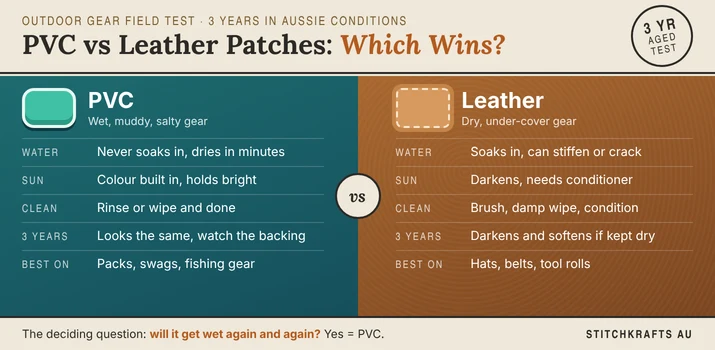
Quick answer: For gear that gets wet, muddy, or splashed with salt, PVC wins. It does not soak up water, and the colour holds in the sun. For gear that stays mostly dry and under cover, like hats, belts, and tool rolls, leather is a great choice, because it looks better the longer you use it. The deciding question is simple: will it get wet again and again?
Everyone says PVC beats leather outdoors. That is mostly true, but it is not the full story. Leather has real strengths, and PVC has real weak spots. This guide shows where each one wins, and what happens to both after three years in Australian conditions.
First, What Are We Comparing?
PVC patches are made from a soft, rubbery plastic that is poured into a mould and set. The colours are part of the material. They are bendy, slightly raised, and they wipe clean.
Leather patches are cut from real or faux leather, and the design is pressed in or engraved. The look is natural and a little rough, and it softens with age.
One is a plastic that ignores water. The other is a natural material that loves a dry life. That single difference drives almost everything below.
Weighing up woven patches too? See our guide to PVC vs woven patches for outdoor gear.
The 3 Year Test: How Each One Ages
Most comparisons tell you how patches look on day one. Here is what happens after three years of real use.
| After 3 Years | PVC | Leather |
|---|---|---|
| Colour | Still bright, since colour is part of the material | Darkens and softens, which many people like |
| After many wet days | Looks the same | Can dry stiff, curl, or crack |
| After mud | Wipes clean | Stains and needs careful cleaning |
| After strong sun | Holds colour well | Can dry out and fade without care |
| Edges | Can start to lift if the backing is weak | Can curl or fray at the stitching |
| The big risk | Backing or stitching letting go | Water damage over many wet cycles |
So PVC tends to look the same for a long time, and then fail at the attachment. Leather changes slowly, and the change is a feature if it stays dry, but a problem if it keeps getting soaked.
Where Does the Patch Go? A Map of Your Gear
The right answer depends on where the patch sits. Here is a simple map.

- The lid or front of a backpack. It gets rain, sun, and scrapes from branches. PVC wins.
- The side pocket of a pack. It gets rubbed against trees, car doors, and boat gunwales. PVC wins, since it shrugs off rough handling and wipes clean.
- A swag or tent bag. It is often packed away damp and tossed in a ute tray. PVC wins.
- Fishing and boat gear. Salt water is hard on leather. PVC wins clearly. Rinse it with fresh water afterwards.
- A hat, like a bucket hat or a stockman style hat. It sits in the sun, but usually stays out of the rain. Leather works well here and looks great. PVC also works, but it can feel stiff on a soft hat.
- A belt, tool roll, or leather bag. It stays dry and gets handled a lot. Leather wins, since it matches the material and ages well.
- A canvas ute cover or camp bag. It lives outside, so PVC suits it better. If the patch sits under a flap, leather can work.
Look at that list. Leather wins when the gear stays dry. PVC wins when it does not.
Water: The Big One
PVC does not soak up water. Rain rolls off, and it dries in minutes.
Leather does soak it up. Water can make leather dry stiff, and repeated soakings can make it warp or crack. That is why leather patches on a hat that gets caught in a downpour now and then are fine, but leather patches on a fishing bag that is wet every weekend are not.
If your gear gets wet once a month, leather can cope. If it is wet every week, choose PVC.
Sun and Heat: The Aussie Test
Strong sun fades colour and dries out natural materials. PVC holds its colour well in the sun, since the colour is built in.
Leather can dry out and fade in direct sun, especially if it is never cared for. A little leather conditioner, applied once or twice a year, helps a lot.
Heat is trickier than it sounds. Leather copes with warmth well. But a patch left in a hot car boot all summer is a test for any material. PVC can soften in extreme heat, so avoid leaving gear in a closed car in the middle of the day. It is worth keeping both types out of that kind of heat.
Mud, Dust, and Dirt
Outdoor gear gets filthy. Here is how each one cleans up.
PVC: Rinse it, or wipe it with a damp cloth. A soft brush handles stubborn dirt.
Leather: Brush off dry dust. For mud, wipe gently with a barely damp cloth, let it air dry away from direct heat, then condition it. Do not put leather in the washing machine, since heat and spinning can shrink or warp it.
PVC is far easier for people who do not want to think about cleaning.
How Do They Attach?
PVC patches usually attach with Velcro, or by sewing through holes at the edge. Velcro is handy on packs, since you can move the patch between bags. Do not iron PVC, because heat can damage the rubber.
Leather patches are best sewn on. Heat from an iron can scorch leather. Use clips, not pins, to hold the patch in place while you sew, because pins leave small holes. Sew with strong thread and a needle made for leather.
Look and Feel
This is where leather fights back.
Leather has a natural grain, a warm tone, and a handmade look. It looks special on a hat, a belt, or a workwear jacket. As it ages, it gets darker and softer, and many people think it looks better after a few years.
PVC is bold, bright, and modern. It can show fine details and strong colours that leather cannot. It suits gear where being seen and being tough matter more than looking traditional.
If your brand is about heritage and craft, leather fits the story. If it is about adventure and performance, PVC fits better.
Which Wins? Your Quick Decision Guide
Answer these three questions.
- Will the patch get wet often? Yes means PVC. No means either.
- Do you want a natural, aged look? Yes means leather, if the answer to question 1 was no.
- Do you want to wipe it clean and forget about it? Yes means PVC.
If you answered yes to question 1 or 3, go PVC. If you answered no to question 1 and yes to question 2, go leather.
Can You Use Both?
Yes. A smart combination is a PVC patch on the outside of a pack, where it takes the weather, and a small leather patch on a hat or on an inside flap, where it stays dry and looks smart. Many outdoor brands also use PVC on gear and leather on caps, so the whole range works together.
Common Mistakes to Avoid
Choosing leather for gear that is wet every week. Leaving any patch in a hot car all day. Ironing a PVC or leather patch. Washing leather in the machine. Using pins on leather, which leave holes. Forgetting to condition leather once or twice a year. And choosing a patch only for looks, then ignoring where it will live.
Frequently Asked Questions
Which is better for outdoor gear, PVC or leather patches?
PVC is better for gear that gets wet, muddy, or salty. Leather suits gear that stays mostly dry, like hats and belts.
Are leather patches waterproof?
No. Leather soaks up water, can dry stiff, and can crack after many wet cycles. PVC does not soak up water.
Do PVC patches fade in the Australian sun?
They hold their colour much better than most materials, since the colour is part of the patch. No material is completely immune to years of direct sun.
Can I wash a leather patch?
Do not machine wash it. Wipe it gently with a barely damp cloth, let it air dry, and condition it afterwards.
How do I attach a PVC patch to a backpack?
Use Velcro backing, or sew it through the edge holes. Do not iron it.
Can leather patches go on hats?
Yes. Hats usually stay out of the rain, so leather patches work well and look great.
Ready to Choose?
If your gear lives in the rain, mud, and sun, our PVC patches are built to handle it. If you want a natural, premium look for a hat, belt, or bag, our leather patches are made for exactly that. Not sure which fits? Browse our custom patches, or tell StitchKrafts Australia where the patch will live and we will help you choose. We work with outdoor brands, clubs, and small businesses in Sydney, Brisbane, and right across the country.