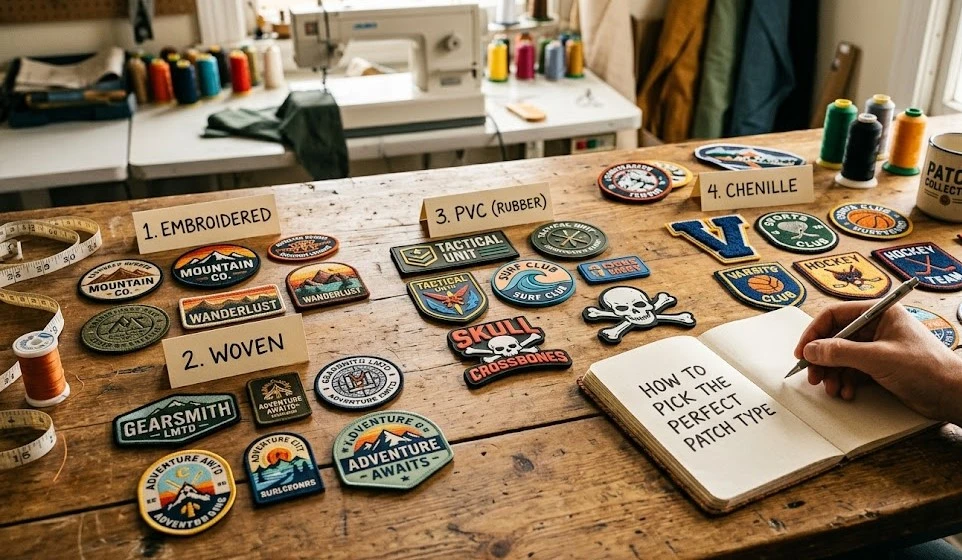
How to Pick the Perfect Patch Type for Custom-Made Patches
Your design tells you which patch type to use.if you know how to read it. Here's the no-confusion guide.
Quick Answer
Simple designs with bold lines and solid colors: choose embroidered patches.
Small text and fine detail: choose woven patches.
Gradients, photographs, or more than 12 colors: choose dye sublimation patches.
For outdoor or heavy-duty use, choose PVC patches.
Vintage or classic aesthetic: choose felt patches.
When in doubt, share your artwork with your supplier first. The design decides everything.
Why Patch Type Matters More Than Most People Realize
Ordering custom-made patches without matching the patch type to your design is the most common and most avoidable mistake in the process.
A logo with tiny text ordered as an embroidered patch comes back blurry and unreadable. A bold, simple crest, ordered as a dye-sublimation patch, looks flat when it could have had texture and depth. The patch type is not just an aesthetic choice. It determines whether your design reproduces accurately at all.
This guide covers every major patch type, what each one does well, and exactly when to use it. Whether you're ordering custom-made patches for a business in Chicago, a youth sports club in Dallas, or personal use anywhere else, the same decision framework applies.
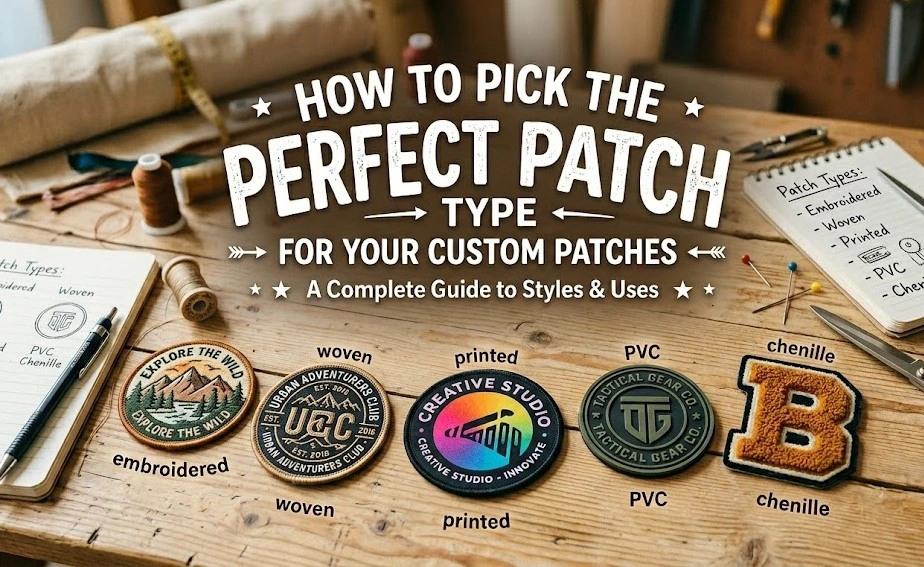
The 6 Main Custom Patch Types
1. Embroidered Patches
The classic. Dense thread stitched onto a woven base, with a raised texture that gives patches their traditional, tactile quality. Embroidered patches have been the standard for uniforms, clubs, and branded merchandise for decades, and for good reason.
Best for:
Bold, clean-lined logos and artwork
Solid colors with clear separation between sections
Lettering of at least ¼ inch tall
Designs where a raised, premium feel matters
Not suitable for:
Gradients or color blending
Photography or highly detailed illustrations
Very small fine lines or text under ¼ inch
Embroidered patches support up to 12 thread colors and come with merrowed, laser-cut, or stitched border options. Available backings include iron-on heat seal, sew-on, hook-and-loop, pin, and plastic. Minimum order is typically 50 patches.
Custom digitizing services are required to convert your artwork into embroidery-ready stitch files before production begins. If your design is a JPEG or PNG, a good supplier will handle this conversion. StitchKrafts USA includes custom digitizing services as part of the order process, which ensures the stitch file accurately reflects your original artwork before a single patch is made.
2. Woven Patches
Where embroidered patches have a raised texture, woven patches are flat. The design is woven directly into the fabric at a finer thread count, which allows for significantly more detail in a smaller area.
Best for:
Intricate designs with fine lines
Small lettering under ¼ inch that embroidery cannot reproduce cleanly
Designs that need a modern, flat look rather than traditional texture
Complex logos with multiple small elements
Not suitable for:
Gradients
Photographic imagery
Designs where raised texture is part of the intended look
Woven patches support up to 10 colors and share the same backing options as embroidered patches. Minimum order is typically 100 patches.
If your logo has small print that always looks soft on embroidered patches, woven is almost certainly the right switch.
3. Dye Sublimation Patches
Dye sublimation patches reproduce artwork with photographic precision. The design is sublimated directly onto a flat twill base, meaning the image is embedded into the fabric rather than sitting on top of it.
Best for:
Gradients and color transitions
Photographic or painterly designs
Artwork with more than 12 colors
Designs where exact color matching matters
Not suitable for:
Designs where raised texture or embroidered feel is required
Applications where a flat printed look does not suit the garment
Dye sublimation patches support unlimited colors, making them the only viable option for complex multi-color artwork. A minimum image resolution of 300 dpi is required for accurate reproduction.
Available borders include merrowed and laser-cut. Backings include iron-on heat seal, hook and loop, and plastic.
4. PVC Patches
PVC patches are molded rubber, three-dimensional, waterproof, and built for conditions that would degrade fabric patches quickly. They are the standard choice for outdoor gear, tactical equipment, and any application where weather resistance matters.
Best for:
Outdoor, tactical, and military applications
Bags, backpacks, and gear exposed to rain and UV
Bold designs that benefit from 3D relief
Hook and loop morale patch applications
Not suitable for:
Fine text or intricate detail because PVC molding has limits on minimum line thickness
Garments where a fabric patch aesthetic is required
Iron-on application because PVC patches are almost always sew-on or hook and loop backed
PVC patch services from quality suppliers like StitchKrafts USA produce patches with clean mold lines, consistent color, and durable construction that holds up to extended outdoor use.
If you need a patch that genuinely does not care about weather, PVC is the answer.
5. Felt Patches
Felt patches share many qualities with embroidered patches, including clean lines, solid colors, and lettering at a minimum of ¼ inch. However, they deliver a softer, vintage aesthetic that embroidery does not replicate.
The felt base gives the patch a classic look associated with letterman jackets, scout badges, and heritage branding.
Best for:
Vintage or retro design aesthetics
School, club, and letterman applications
Simple artwork with bold lines and solid fills
Designs where a softer, matte finish suits the garment
Not suitable for:
Fine detail, small text, or gradients
Outdoor or heavy-wear applications where durability is critical
Felt patches support up to 12 thread colors and come with merrowed, laser-cut, and stitched borders. Available backings mirror the embroidered patch range. Minimum order is typically 50 patches.
6. Combination Patches
Combination patches blend two techniques in a single patch, typically a sublimated background with embroidery layered on top.
This creates genuine three-dimensional depth, with a photographic or gradient background and raised embroidered elements sitting above it.
Best for:
Designs that are too complex for embroidery alone but need texture
Logos where a background image and bold foreground elements coexist
Premium branded merchandise where visual impact matters
Combination patches support unlimited colors due to the sublimation component, and all standard border and backing options apply.
Quick Reference: Which Patch Type for Your Design?
| Design Characteristic | |
| Bold logo, solid colors | Embroidered |
| Small text under ¼ inch | Woven |
| Gradients or photography | Dye Sublimation |
| More than 12 colors | Dye Sublimation |
| Outdoor or waterproof use | PVC |
| Vintage or classic feel | Felt |
| Complex background plus raised detail | Combination |
A Word on Custom Digitizing Services
Every embroidered and woven patch starts with a digitized file, a stitch-by-stitch instruction set that tells the embroidery machine exactly how to reproduce your design.
No matter how good your artwork is, a poorly digitized file produces poor patches.
Custom digitizing services convert your logo, illustration, or design into a production-ready embroidery file. This is not the same as simply importing an image. It requires decisions about stitch direction, density, color sequencing, and compensation for how thread behaves at different scales.
If you're ordering embroidered patches for the first time, make sure your supplier includes custom digitizing as part of the process and provides a sample for approval before full production begins.
StitchKrafts USA provides a real physical sample, not just a digital preview, before production runs. This means you see exactly what the finished patch looks like before committing to the full order.
Iron a Patch on a Hat? Match the Patch Type First
If you plan to iron a patch on a hat, the patch type matters as much as the technique.
Embroidered and woven patches with heat seal backing bond well to cotton caps when applied correctly. Iron to maximum heat, use no steam, apply a circular press motion for 15 seconds, then press the edges specifically.
PVC patches should never be ironed on. Use hook and loop or sew-on backing for headwear.
Custom chenille patches should always be sewn rather than ironed, regardless of hat or garment type.
Matching the right patch type to the right application method is what separates a patch that lasts years from one that peels in weeks.
Frequently Asked Questions
What is the difference between embroidered and woven patches?
Embroidered patches have a raised thread texture and suit bold, simple designs.
Woven patches are flat with a finer thread count and suit intricate designs with small text and detail.
Both use similar backings and borders. The design complexity is what determines which to choose.
What patch type is best for a logo with gradients?
Dye sublimation patches.
Embroidered and woven patches cannot reproduce gradients or color blending. Sublimation handles unlimited colors and photographic detail accurately.
What are PVC patches used for?
Outdoor gear, tactical equipment, bags, and any application requiring a waterproof, weather-resistant patch.
PVC patches are molded rubber with 3D relief and are almost always used with hook-and-loop or sew-on backing.
Do I need custom digitizing services to order embroidered patches?
Yes.
Every embroidered patch requires a digitized stitch file converted from your artwork. Quality suppliers include this in the order process.
Always confirm a physical sample is provided before production begins.
What is the minimum order for custom-made patches?
Typically, 50 patches for embroidered and felt types, and 100 patches for woven and dye sublimation.
Minimums vary by supplier and patch type.