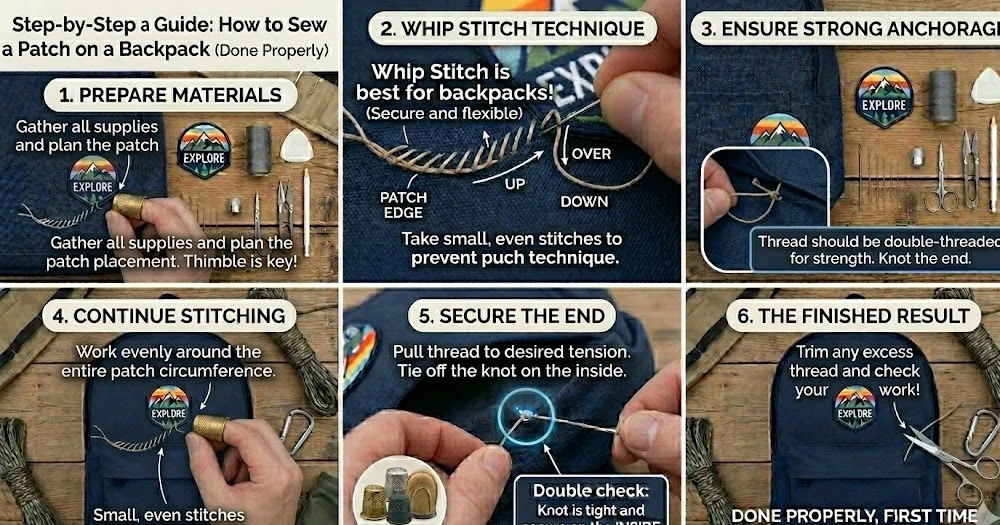
How to Sew a Patch on a Backpack (Done Properly, First Time)
No sewing experience needed. No expensive kit. Just a needle, some thread, and a patch worth keeping.
Quick Answer
Pin your patch where you want it on the backpack. Thread a needle with about 20 inches of thread and stitch all the way around the edge. Tie it off on the inside and trim the thread. If your patch has iron-on backing, bond it with heat first, then sew over it for a hold that will not come loose. The whole job takes under 20 minutes.
Why People Across the UK Are Sewing Their Patches On
Walk through any secondary school in Manchester, any market in Camden, or any university corridor in Edinburgh and you will see backpacks covered in patches. Custom embroidered designs, band logos, football club badges, travel crests, and personalised pieces from StitchKrafts UK.
But here is the problem most people run into: iron-on patches do not always hold as well as the packaging suggests. British weather, damp commutes, rainy school runs, bags stuffed into wet cycle panniers in Bristol or Leeds, puts adhesive under constant stress.
Nylon and polyester backpacks, which make up the majority of bags sold in the UK, are also the worst surfaces for iron-on adhesive. The glue simply does not grip synthetic fabric the way it grips cotton or denim.
Sewing fixes all of that. A stitched patch holds through washing, rain, and years of daily use. It does not peel. It does not lift at the corners. It stays exactly where you put it.
How Do You Attach Patches to Backpacks?
There are three ways to attach a patch to a backpack.
Sewing Only
The strongest option. Works on every material including nylon, canvas, polyester, and leather. No heat required. Lasts for years regardless of weather or how often the bag is washed.
Iron-On Only
Quick and easy, but unreliable on synthetic fabrics. Best suited to cotton and canvas bags. On the nylon rucksacks common in the UK, iron-on adhesive alone rarely holds long-term.
Iron First, Then Sew
The best of both methods. Bond the patch with heat so it sits perfectly still, then stitch around the border to make it permanent. This is the recommended approach for any bag used daily.
What You Will Need
Everything on this list is available at Hobbycraft, John Lewis, or any haberdashery section of a department store.
| Item What It Does | |
| Sewing needle (medium sharp) | Piercing through the patch and bag fabric |
| Thread about 20 inches per patch | Stitching the border |
| 2 to 3 safety pins | Holding the patch still before you start |
| Scissors | Trimming the thread when finished |
| Thimble | Protecting your thumb on thick canvas or waxed fabric |
| Iron and thin cotton cloth | Only if your patch has heat-seal backing |
You do not need a sewing machine. This is entirely hand-stitching, straightforward enough for a complete beginner on their first attempt.
Step-by-Step: How to Sew a Patch on a Backpack
Step 1: Choose Where the Patch Goes
Lay the backpack flat on a hard surface. A kitchen table or worktop works well.
Hold the patch against the bag in a few different positions before committing.
Two things to avoid:
Seams
The thick stitched lines running along the edges and corners of the bag. Sewing through a seam is significantly harder than sewing through flat fabric and will blunt your needle quickly.
Internal Layers
Most backpacks have dividers, padding, or a laptop sleeve behind the outer panel. You want to stitch through the outer fabric only. Before you start, open the bag and slide a thick paperback book or piece of cardboard behind the panel you are working on. This separates the outer layer from everything inside and prevents you accidentally stitching the bag shut.
Once you have chosen your spot, you are ready to begin.
Step 2: Heat Bond First (Skip for Nylon or Waterproof Bags)
If your patch has iron-on backing and your bag is cotton or canvas, do this step first. If your bag is nylon, polyester, or waterproof, skip straight to Step 3. Heat can melt or distort synthetic fabrics.
- Lay the bag flat on a firm, heat-safe surface. An ironing board works perfectly.
- Place a thin cotton cloth over the area where the patch will go.
- Press with a hot iron for a few seconds to warm the fabric.
- Remove the cloth and place the patch exactly where you want it.
- Drape the cloth back over the patch.
- Press straight down with a hot iron for up to 60 seconds. Do not slide the iron.
- Lift carefully and check all four corners. If any lift, press again.
This bonds the patch in place before sewing so it cannot shift while you stitch.
Step 3: Pin the Patch
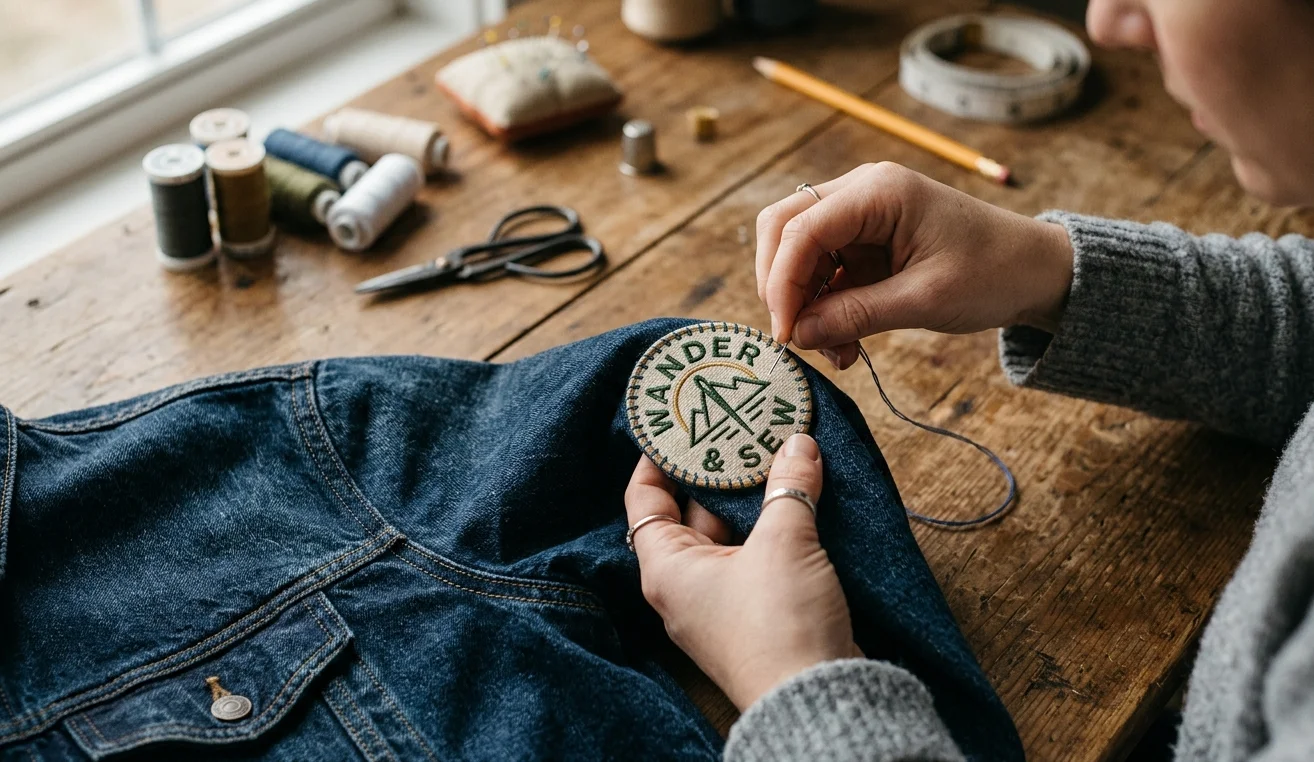
Use two or three safety pins to hold the patch flat against the bag.
Check that it lies completely flat with no bubbling, no lifted corners, and no drift to one side. A patch that is not flat before you sew will look uneven after.
Step 4: Thread the Needle
Cut about 20 inches of thread. Fold it in half to find the midpoint, form a small loop, and push that loop through the eye of the needle. You now have doubled thread, stronger and more reliable than a single strand.
Leave about 3 to 4 inches of loose ends on one side. Do not knot yet.
Matching thread blends into the patch border for a clean, invisible finish. Contrasting thread turns the stitching into a visible design feature. Both are legitimate choices. It comes down to the look you want.
Step 5: Start the First Stitch
Starting at one corner of the patch:
- Push the needle through the very edge of the patch and down into the backpack fabric beneath it.
- Pull the thread through until a small 1-inch loop remains at the entry point.
- Bring the needle back up from inside the bag, through the edge of the patch.
- Pass the needle through that loop.
- Pull gently but firmly until the loop closes flat against the fabric.
This locks the thread in place without any knot showing on the surface. It is the only slightly fiddly part of the whole process, so take your time on this first stitch and everything that follows becomes straightforward.
Step 6: Stitch Around the Full Border
Continue around the full edge of the patch.
- Push the needle down through the patch edge and into the bag.
- Bring it back up from inside, through the patch edge.
- Pull firm after each stitch.
Keep stitches roughly 3 to 5 millimetres apart. Even spacing gives a neat, professional finish rather than a rushed-looking result.
Use the thimble on your thumb if you have one. Waxed cotton bags, heavy canvas rucksacks, and the thick panels on school bags can resist the needle more than lighter fabric.
Work steadily all the way around the full border.
Step 7: Lock the Thread Off
When you have gone all the way around and returned to where you started:
- On your last inward stitch, leave a small loop instead of pulling tight.
- Bring the needle back through from the inside and pass it through that loop.
- Pull snug.
- Repeat three to four more times in the same spot.
These finishing stitches create a secure anchor that will not loosen with use.
Step 8: Trim and Check
Snip the thread close to the fabric on the inside of the bag. Leave about 5 millimetres so it cannot slip back through. Remove all safety pins.
Turn the bag over and look at the patch from the front. The stitching should sit flush and even around the full border with consistent tension all the way round.
If one section looks slightly uneven, do not worry. A little variation in hand-stitching is completely normal and gives the patch a handmade quality that machine work does not replicate.
How to Put a Patch on a Backpack Without Sewing
If you would rather not sew, there are two no-sew options worth knowing about.
Iron-On Bonding
Works reliably on cotton and canvas bags. Place a thin cloth over the area, warm with a hot iron, position the patch, cover again, and press firmly for up to 60 seconds. Leave it to cool completely before handling.
This holds well on heavier cotton bags used for school or everyday carry. On nylon and polyester rucksacks, iron-on adhesive alone tends to peel within weeks.
Fabric Glue
A better no-sew option for synthetic bags. Use a fabric adhesive rated for synthetic materials, such as Bostik Fabric Glue or similar products available at Hobbycraft or online.
Apply a thin, even layer to the back of the patch, press firmly, and leave completely flat for 24 hours before use.
Fabric glue holds better than iron-on adhesive on nylon, but it still will not match the long-term durability of stitching for a bag used daily.
How to Patch a Ripped Backpack
A torn panel or worn-through section of a backpack can be repaired using exactly the same sewing method above.
For a Small Hole or Tear
Choose a patch at least 1 centimetre larger than the tear on all sides. Position it over the damage on the outside of the bag. Slide cardboard inside behind the tear, pin the patch flat, and sew around the full border.
For a Larger Tear or Worn-Through Section
Use two patches, one on the outside and one on the inside of the same area. Align them so the tear is sandwiched between them, then stitch through both layers from the outside. This creates a reinforced repair that holds even under load.
For a Decorative Repair
Cover the damage entirely with a custom embroidered patch and stitch it down securely. Nobody sees the tear. They see a great-looking patch.
How to Sew a Patch for Beginners
If you have never sewn anything before, sewing a patch onto a backpack is one of the simplest hand-sewing projects there is.
Start with a Small Patch
Choose something around 5 to 7 centimetres for your first attempt. A smaller patch means a shorter border and less time for your hand to tire.
Use Proper Thread
Thicker thread is easier to see, easier to handle, and more forgiving if your tension is slightly uneven. Buttonhole thread or heavy-duty polyester thread works far better than the thin thread that comes in basic sewing kits.
Go Slowly on the First Stitch
The locking stitch is the only part that needs concentration. Once that is done, the rest is simply repeating the same motion around the patch.
Do Not Pull Too Tight
Overtightening causes the backpack fabric to pucker and bunch around the patch. Pull until the thread lies flat and snug, not until the fabric gathers.
Practice on Spare Fabric First
Take an old piece of canvas or spare cloth and run through the stitching motion a few times. Five minutes of practice takes the uncertainty out of the real job.
Custom Chenille Patches
Custom chenille patches are the thick, plush, velvety patches associated with varsity jackets and premium streetwear.
Sewing is the only reliable attachment method for chenille patches because heat can flatten the texture permanently.
For Chenille Patches Specifically
- Use a denim needle.
- Use heavy-duty thread.
- Stitch through the flat woven base at the edge of the patch.
- Never apply a hot iron directly to the chenille pile.
StitchKrafts UK custom chenille patches are made with a solid sew-on base that lies flat and takes the needle cleanly.
Different Backpack Materials: What to Know
| Material Can You Iron? Best Method to Watch Out For | |||
| Canvas | Yes | Iron then sew | Check for wax coating first |
| Cotton | Yes | Iron then sew | Always use a cloth barrier |
| Nylon | No | Sew only | Heat melts or distorts the surface |
| Polyester | No | Sew only | Adhesive does not grip reliably |
| Waterproof coated | No | Sew only | Iron destroys the coating |
| Waxed cotton | No | Sew only | Heat strips the wax finish |
| Leather | No | Sew only | Use a leather needle; beeswax helps |
The majority of everyday UK school bags, commuter rucksacks, and travel backpacks are nylon or polyester, meaning sewing is almost always the correct method regardless of patch type.
Removing an Old Iron-On Patch Before Applying a New One
Place a thin cloth over the old patch and press with a warm iron or hair dryer for 20 to 30 seconds.
Once the adhesive softens, use tweezers to lift one corner and peel slowly at a low angle. If it resists, reheat rather than pulling hard.
For nylon bags, use a hair dryer on medium heat only.
After peeling, remove sticky residue with warm soapy water and a cloth. For stubborn glue, use a fabric-safe adhesive remover. Avoid acetone, nail varnish remover, or harsh solvents.
Does Patch Quality Make a Difference?
Yes, significantly.
A cheap patch has uneven edges, weak backing, distorted borders, and thread colours that fade quickly.
A well-made patch has a clean, firm border that guides your needle naturally. The backing stays flat. The colours hold through washing, rain, and daily use.
StitchKrafts UK produces custom embroidered and chenille patches with clean merrowed borders, consistent backing, and durable thread quality.
Frequently Asked Questions
How do you attach patches to backpacks?
The three main methods are sewing, iron-on bonding, and a combination of both. Sewing is the most durable and works on all materials including nylon and waterproof bags.
How do you patch a ripped backpack?
Place a patch over the tear with at least 1 centimetre of overlap on all sides, pin it flat, and sew all the way around the border. For larger tears, use a second patch on the inside for reinforcement.
How do you sew a patch for beginners?
Pin the patch in position, thread a needle with doubled thread, and stitch evenly around the edge. Finish with loop stitches to lock the thread securely.
How do you put a patch on a backpack without sewing?
Use iron-on bonding for cotton and canvas bags. For nylon or polyester bags, use fabric glue rated for synthetic materials.
Can you sew a patch on a nylon rucksack?
Yes. Sewing is actually the best method for nylon because iron-on adhesive rarely grips synthetic materials reliably.
How long does it take to sew a patch on a backpack?
A standard embroidered patch takes 10 to 20 minutes by hand. Larger chenille patches may take 20 to 30 minutes.
Can you remove a sewn patch later?
Yes. Use a seam ripper to cut each stitch carefully around the border, then peel away any remaining adhesive if needed.
The One Thing That Makes Every Patch Job Easier
Slide a piece of cardboard inside the bag before you pick up the needle.
It takes ten seconds. It prevents the single most common beginner mistake, accidentally stitching straight through to the other side of the bag and sealing it shut.
Everything else, the tension, the spacing, the finishing, you will work out as you go. It is genuinely easier than it looks, and every patch you sew makes the next one faster.