

Order Custom Patches in Bulk Without Overpaying: Get a Quote
Quick answer: To get a fair bulk patch quote, send one complete brief with your design, size, backing, date, and three quantities, such as 100, 250, and 500. Ask for an all in total with every fee listed. Then compare the final totals, not the price per patch. A quote with a higher unit price can still cost less once fees, backing, and shipping are added.
Getting a quote should take one email. For many buyers it takes a week, because the supplier needs five details the buyer forgot to send. This page gives you a quote brief to copy, shows how to read a quote line by line, and lists the moves that actually lower your price.
Step 1: Send a Complete Brief
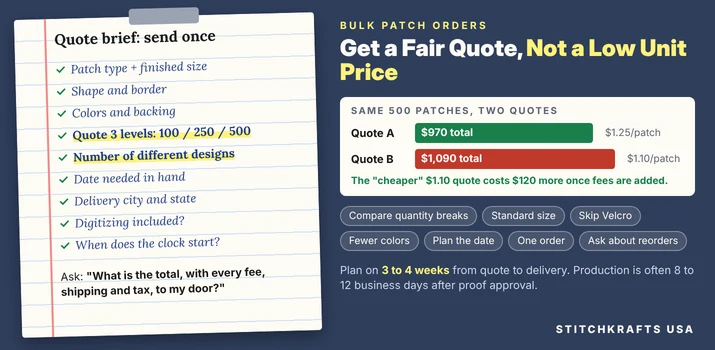
Copy this, fill it in, and send it with your logo. It answers most of what a supplier needs to ask.
- Company or team name:
- Patch type (embroidered, woven, PVC, chenille, leather):
- Finished size (width and height in inches):
- Shape (round, square, shield, custom):
- Border (stitched edge or cut edge):
- Colors (names, or exact color codes if you have them):
- Backing (sew on, iron on, Velcro, adhesive):
- Quantity: please quote 3 levels, for example 100, 250, and 500
- Number of different designs:
- Date I need them in hand:
- Delivery city and state:
- Questions: is digitizing included, how long is production, and when does the clock start?
Two lines matter most. The first is "quote 3 levels." It shows you where the price drops, so you can decide how many to buy. The second is "number of different designs." Many suppliers charge setup per design, so five designs can cost more than one.
If your logo is a blurry photo, say so. A supplier can clean it up, and a vector art service turns rough artwork into sharp lines before production, which avoids delays later.
Step 2: Ask for a Total, Not a Unit Price
The price per patch is the number everyone advertises, and it is the least reliable number on a quote.
Ask each supplier this exact question: "What is the total I will pay, with every fee, shipping, and tax, from proof approval to my door?"
A supplier who answers with one clear number is easy to compare. A supplier who answers with "it depends" needs a follow up.
Step 3: Learn to Read a Quote
Here is a made up example. The numbers are round, for illustration only. The notes beside each line tell you what to ask.

Quote A: 500 embroidered patches, 3 inches, with Velcro
| Line | Amount | What to Ask |
|---|---|---|
| Patches, 500 at $1.25 | $625.00 | Is this size, coverage, and border exactly what I asked for? |
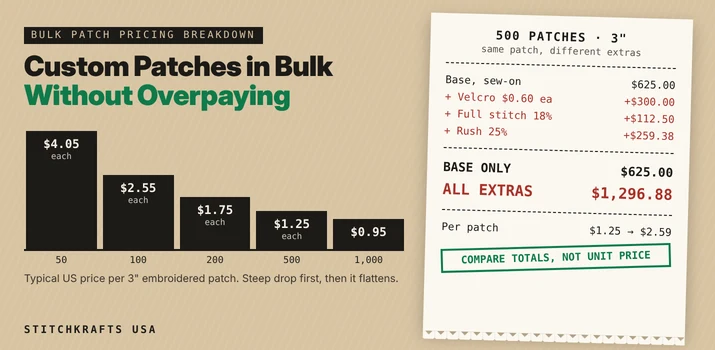
| Velcro backing, 500 at $0.60 | $300.00 | Is Velcro charged on every patch? Would sew on or iron on be free? |
| Digitizing and setup | $0.00 | Is it truly included, and is it per design? |
| Proof | $0.00 | Will I get a proof before anything is made? |
| Shipping | $45.00 | Is it a flat fee, and how long will delivery take? |
| Total | $970.00 | That is about $1.94 each |
Now compare it with a second quote for the same order.
Quote B: the cheaper looking one
| Line | Amount |
|---|---|
| Patches, 500 at $1.10 | $550.00 |
| Digitizing | $75.00 |
| Proof fee | $30.00 |
| Velcro backing, 500 at $0.75 | $375.00 |
| Shipping | $60.00 |
| Total | $1,090.00 |
Quote B advertised $1.10 per patch. Quote A said $1.25. But Quote B costs $120 more once every line is added. That is why you compare totals.
Step 4: Pull the Levers That Lower Your Price
These are the moves that genuinely work. They are not tricks, just choices.
- Compare quantity breaks. Ask what the next 100 cost. Doubling from 100 to 200 can add far less than you expect. In one published table for a 3 inch patch, 100 cost $264 and 200 cost $348, so 100 extra patches cost only $84.
- Choose a standard size and shape. A smaller patch uses less thread. In the same table, a 2 inch patch at 500 pieces was about 40 cents cheaper per patch than a 3 inch one. Custom shapes can add a cutting charge.
- Skip Velcro unless you need it. It often adds about 55 to 65 cents per patch, which is $275 to $325 on 500. Sew on is usually free, and iron on is often a few cents.
- Keep your colors down. Fewer thread colors means simpler production. Extra colors or full stitching can add around 15 to 20 percent.
- Plan your date. Rush production can cost about a quarter of your order at some suppliers. Ordering early avoids it.
- Put several patches in one order. Fewer shipments means fewer shipping charges, and it keeps colors consistent.
- Ask about reorders. If your design is kept on file, a reorder should not carry the same setup again. Some suppliers also discount reorders.
Step 5: Know the Timeline
Here is a typical flow. Your supplier's exact timing will differ, so ask.
| Stage | Typical Time |
|---|---|
| Quote reply | Same day to 2 days |
| Mockup or proof | About 12 to 24 hours after you place the order |
| Your approval | As fast as you check it |
| Production | Often about 8 to 12 business days after you approve the proof |
| Shipping | A few days |
Add it up, and plan on three to four weeks from quote to delivery for a standard order. Always ask when the clock starts, at payment or at proof approval, since that can move your date by a week.
Step 6: Check the Proof Like a Contract
A proof is a picture of your finished patch, sent before anything is made. Treat it as your last chance to catch a mistake.
Check the spelling letter by letter. Check the size in real inches. Check the colors, the border, and the backing. Look at every word. Then approve it in writing, and keep a copy until the order arrives.
What a Good Supplier Will Tell You Without Being Asked
A supplier worth ordering from usually offers these without pushing.
- A clear total, with every fee shown.
- A proof before production.
- A plain answer on when the clock starts.
- Honest advice if your design has tiny text or too many colors.
- A note on whether your design is kept on file.
- A straight answer on what happens if the patches arrive wrong.
If any of these are missing, ask again in writing.
Which Patch Type Is Cheapest?
For most buyers, embroidered patches have the widest price range and the lowest minimums. If you want a classic stitched look at a fair price, embroidered patches are the usual starting point. Other types, like PVC and chenille, cost more per patch, so choose them for a reason, not by default.
Common Mistakes to Avoid
Comparing only the price per patch. Not asking for three quantities. Adding Velcro without checking it is needed. Forgetting that setup may be charged per design. Leaving the date until the last minute and paying for rush. Approving a proof without reading every letter. And not asking what a reorder costs.
Frequently Asked Questions
How do I get a quote for bulk custom patches?
Send your design, size, backing, quantity, date, and location. Ask for quotes at three quantities, with an all in total.
What should a patch quote include?
The price for the patches, backing, digitizing or setup, proof, shipping, and tax, with every line shown and one final total.
How can I lower the price of a bulk patch order?
Order at a bigger quantity break, choose a standard size, skip Velcro if you do not need it, keep colors down, and order early to avoid rush fees.
How long does a bulk patch order take?
Often about three to four weeks from quote to delivery. Production alone is commonly around 8 to 12 business days after proof approval.
Should I compare the price per patch?
No. Compare the final totals, since fees, backing, and shipping can change which quote is cheapest.
Can I reorder the same design later?
Usually, if your supplier keeps your design on file. Ask before your first order, and ask whether a reorder costs less.
Ready to Get Your Quote?
Fill in the brief above and send it to us with your logo. Browse our custom patches to see the types, backings, and options first, then ask us for your three quantities with every fee listed line by line. StitchKrafts USA works with schools, teams, and businesses in Chicago, Austin, and across the country, and we will tell you honestly what is possible for your date.