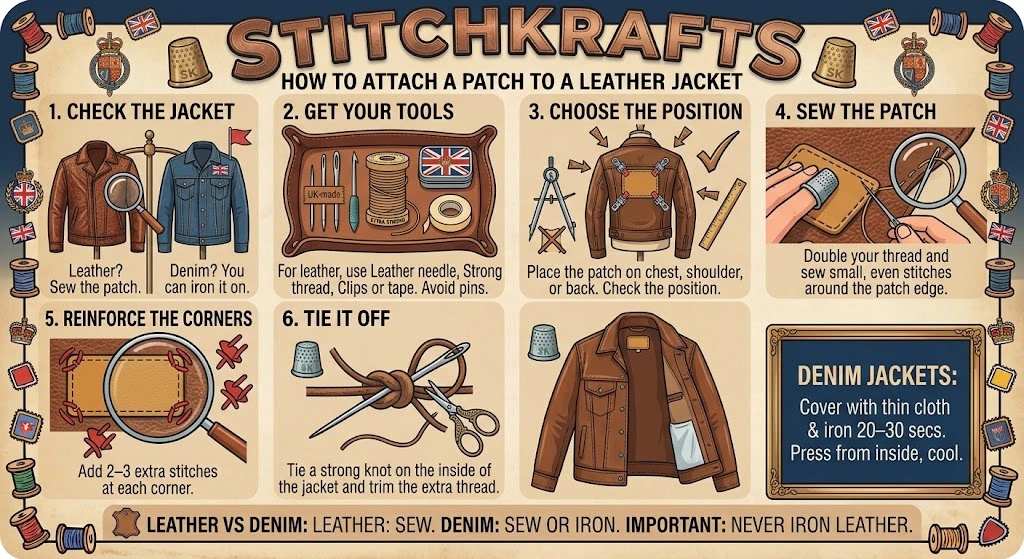
How to Attach a Patch to a Leather Jacket the Right Way
Quick answer: Leather needs sewing. Denim can be ironed. That is the short version. Use clips or tape on leather instead of pins, then sew slowly with a strong needle. If your jacket is denim, an iron works just fine instead.
Not sure which method applies to your jacket? Answer these questions and you will know exactly what to do.
Question 1: Is Your Jacket Leather or Denim?
This is the first thing to check, since it decides everything else.
Leather: keep reading, sewing is your method.
Denim: skip down to the ironing section further below, since heat is safe to use there.
Not sure which one you have? Leather feels smooth and slightly cool to the touch, with no visible weave. Denim has a clear woven texture you can see and feel. If you can spot little threads crossing over each other, it is denim.
Question 2: Do You Have the Right Tools for Leather?
Got a strong needle made for leather? Good, that is what you need. A regular needle tends to bend or get stuck.
Only have a regular sewing needle? It might work on thinner leather, but expect it to struggle. Worth picking up a proper leather needle if you can.
Got clips or tape instead of pins? Perfect, that is exactly right. Pins leave small holes in leather that never disappear, so clips or a bit of light tape are the safer choice for holding your patch in place. If you have not ordered your patch yet, custom leather patches are made with a sturdy edge that holds up well to this kind of stitching.
Question 3: Have You Decided Where the Patch Goes?
Not yet? Lay the patch on the jacket without attaching anything. Step back and look at it properly before deciding. Common spots include the chest, a shoulder, or the back if the patch is larger.
Already decided? Good, move on to the sewing itself.
Question 4: Are You Ready to Start Sewing?
Here is exactly what to do once you have everything in place.
Double your thread for extra strength and knot the end securely. Starting from the inside of the jacket, bring your needle up through the patch, then back down through the leather right beside it. Keep going steadily all the way round the edge.
Sewing evenly and slowly? You are doing this correctly. Leather does not stretch, so uneven stitches show up far more than they would on soft fabric.
Rushing through it? Slow down. This is exactly how mistakes happen on leather, since there is no give in the material to hide an uneven stitch.
Question 5: Have You Reinforced the Corners?
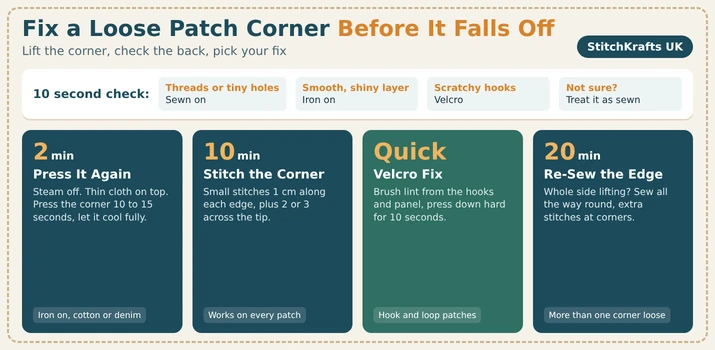
Finished going all the way round but skipped the corners? Go back now and add two or three extra stitches at each one. Corners take the most pulling over time, especially on a jacket worn often, so they need a bit of extra strength.
Already reinforced them? Great, you are nearly done.
Question 6: Have You Tied Off Properly?
Knot tied on the inside of the jacket? Correct, that is exactly where it should be.
Knot on the outside, or no knot at all yet? Fix this before you finish. A loose or exposed thread can catch on something and slowly unravel all your work.
If Your Jacket Is Denim Instead
This section is for anyone who answered Question 1 with denim.
To iron a patch on a denim jacket, place it exactly where you want it and cover it with a thin cloth to protect the fabric. Press a hot iron down firmly for around 20 to 30 seconds. Turn the jacket inside out and press again from the back for a stronger hold. Let it cool completely before wearing it.
Denim can handle heat that would genuinely ruin leather, which is exactly why the two materials need such different treatment. If you are after a patch built specifically for this ironed on look, embroidered patches hold up particularly well through both heat and regular washing.
Deciding Before You Order Your Patch
If you have not ordered your patch yet, it is worth thinking about attachment before you do, rather than after it arrives.
For leather, sewing really is your only sensible choice. Some people prefer to order leather patches with a hook and loop backing instead, which avoids sewing altogether if you like swapping designs from time to time.
For denim, either method works well, though sewing tends to hold up better through repeated washing. For more general tips on placement that apply across different jacket styles, our guide on putting a patch on a jacket is worth a look too.
If Your Design Needs Work First
Sometimes a logo or design is not quite ready to become a patch yet. A vector art service can tidy up rough artwork so the finished result looks sharp rather than blurry.
Once the design is ready, it still needs turning into a stitch file. This happens through embroidery digitising, which is the step that actually makes embroidery on a patch possible.
Common Questions
Does sewing leave visible holes in leather?
Small needle holes are normal, much like any stitched seam, and they are barely noticeable once the patch is attached.
Could a machine sew this instead of doing it by hand?
Some heavy duty machines manage thin leather, but hand sewing gives far more control, especially on a jacket you want to get right.
Is there ever a safe way to iron leather?
Not really. The risk of scorching or stiffening it is too high, which is why sewing stays the reliable option.
Do embroidered patches need different care when sewn onto leather?
No, the same sewing method applies no matter what the patch itself is made from.
How long should a properly sewn leather patch last?
With even stitching and solid corners, it can easily last for years, even with regular wear.
Ready to Get Your Patch Made?
If you are in Birmingham or London, StitchKrafts UK can help you get a patch built for everyday wear and tear, whether that is leather or denim. Already have a design ready? We can turn it into something made to your exact size, shape, and colour.