Choosing Thread Colours That Would Not Fade on Embroidered Patches
Quick answer: The thread type matters more than the colour. Polyester thread keeps its colour through lots of washing and sunshine, while rayon thread fades faster. Choose polyester thread, stay away from neon shades if you want a patch that lasts for years, and ask your patch maker which thread they use before you order.
A patch that looked bright on day one can look dull after a year. That is no fun, especially for a school badge or a club crest. This guide shows you how to pick colours that stay bright.
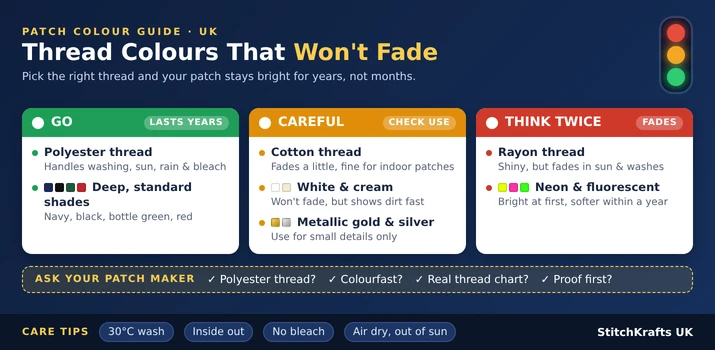
The Colour Traffic Light
Think of thread like traffic lights. Green means go, amber means be careful, and red means think twice.
Green: Go
- Polyester thread in normal colours: Holds its colour through lots of washing, sun, and rain. The best everyday choice.
- Dark, deep colours like navy, black, and bottle green: Show wear and lint less than pale colours, and look smart for years.
Amber: Be Careful
- Cotton thread: Fades a little more than polyester, but it is fine for patches that stay indoors.
- Very pale colours like white and cream: They do not usually fade, but they show dirt and can look grubby.
- Metallic thread, like gold and silver: Looks shiny and special, but it is more delicate than normal thread.
Red: Think Twice
- Rayon thread: Beautiful and shiny, but it can fade with sun and many washes.
- Neon and fluorescent colours: Super bright at first, but they fade faster than normal colours.
Now let’s look at why each one behaves this way.
Step 1: Understand What Thread Is Made Of
Embroidered patches are made from thousands of tiny stitches. The colour of the patch is the colour of the thread, so thread is the thing that fades or stays bright.
There are three main kinds.
Polyester thread is made from plastic fibres. It does not soak up water, so rain and washing do not wash the colour out. It also copes well with sunshine and even with bleach. Most patch makers use it for jackets, uniforms, and anything that gets washed a lot.
Rayon thread is made from plant fibres that have been turned into silky threads. It has a lovely shine, like satin. But it soaks up more water, and it fades faster with sun and washing.
Cotton thread is soft and flat, with no shine. It is in the middle. It fades more than polyester, but not as quickly as rayon.
So if the patch will be washed, rained on, or left in the sun, polyester is the safest pick.
Step 2: Think About Where the Patch Will Live
Different places are tougher on colour. Ask yourself where your patch will be.
A school blazer or jumper. It gets worn every day and washed often. Polyester thread is best, in classic dark colours.
A football or rugby kit. It gets washed after almost every game, and spends time out in sun and rain. Polyester again, and keep it away from hot washes.
A rucksack or school bag. It sits in the sun on the way to school and gets rained on. Polyester thread is the winner. If you want to know more about picking patches for bags, see our guide on the best patch material for rucksacks.
A jacket that stays in the wardrobe most of the time. Almost any thread will last well, so you can pick based on how it looks.
Step 3: Pick Colours That Last
Here are simple rules for choosing colours.
Pick strong, normal colours. Colours like navy, red, royal blue, black, and forest green are standard shades. They are the ones patch makers use most, so they are well tested.
Skip neon if you want it to last. Neon yellow, pink, and green are exciting. But neon dyes fade faster than normal ones. If you love neon for a fashion patch, that is fine. Just know it will look softer after a year or so.
Think twice about white. White thread does not really fade, but it shows dirt. A white patch on a school jumper can look grey after a term. If you want white, wash the item gently and often.
Use gold and silver in small amounts. Metallic thread looks special on a crest or a badge. It is not as tough as normal thread, so use it for small details, not the whole patch.
Match your club or school colours exactly. Ask for a thread colour chart. Most patch makers have one. Pick from the chart, instead of guessing from a screen, since colours look different on a phone.
Step 4: Ask Your Patch Maker These Five Questions
Before you order, ask:
- What kind of thread do you use? The answer you want is polyester.
- Is the thread colourfast? This means the colour will not run or fade easily.
- Can I see a thread colour chart? Real thread, not just a screen picture.
- Can I see a proof? A picture of your design in the real colours, before they start.
- Can you keep my colours on file? That way a reorder next year matches perfectly.
A good patch maker will be happy to answer all five.
Step 5: Know the Patch Type
For colours that stay bright with lots of washing and wear, a well made embroidered patch in polyester thread is a solid choice. It is the classic badge for blazers, kits and uniforms.
If your design is mostly one big, bold colour, and the patch lives outdoors, you might also like rubbery PVC patches. The colour is set right into the material, so there is no thread to fade.
Step 6: Do a Ten Minute Fade Check at Home
Here is a simple test you can do on a spare patch, or a thread sample, if you have one.
- Cut a small piece of the patch, or use a spare.
- Cover half of it with a piece of card, and tape it down.
- Put it on a sunny windowsill for two to three weeks.
- Take the card away and compare the two halves.
- If the covered half looks much brighter, that colour fades in sun.
It is not a lab test, but it gives you a real answer with real sunshine.
Step 7: Wash It the Right Way
Even the best thread lasts longer with a little care.
- Wash on a cold or cool setting, around 30 degrees.
- Turn the item inside out first.
- Use a gentle detergent, and skip bleach, especially with coloured thread.
- Let it air dry where you can, and keep it out of strong direct sun while it dries.
- Skip the tumble dryer if you can.
Do these things and your patch will keep its colour for years instead of months.
Step 8: Why Some Patches Fade Faster Than Others
If you have seen a patch go dull, it was probably one of these.
- Cheap rayon thread was used instead of polyester.
- The patch was washed hot, many times.
- It sat in strong sun for a long time, like on a bag always left by a window.
- A neon or very bright dye was used.
- It was washed with bleach or a harsh detergent.
Most of these are easy to avoid once you know about them.
Common Mistakes to Avoid
- Choosing colours from a phone screen, with no thread chart.
- Picking rayon for a patch that gets washed a lot.
- Choosing neon and expecting it to look the same in two years.
- Not asking which thread is used.
- Using bleach on a coloured patch.
- Leaving a patched bag in the sun all summer.
Frequently Asked Questions
What thread colours fade the least on patches?
Polyester thread in normal, deep colours like navy, black and red fades the least, because polyester copes well with sun and washing.
Does embroidery thread fade in the wash?
Polyester thread keeps its colour through many washes. Rayon and neon threads fade faster, especially in hot water.
Which is better for patches, polyester or rayon thread?
Polyester is better for patches that get washed or used outdoors. Rayon looks shinier but fades faster.
Do neon patches fade?
Yes, neon and fluorescent colours usually fade faster than standard colours, so they may look softer after a year or so.
How do I stop my patch from fading?
Choose polyester thread, wash on a cold setting, turn the item inside out, skip bleach, and avoid long hours in strong sun.
Can I match my school or club colours exactly?
Yes. Ask your patch maker for a thread colour chart and a proof, so you can pick the exact shade before the patch is made.
Ready to Pick Your Colours?
If you are planning a school badge, club crest, or custom design, StitchKrafts UK can talk you through thread choices and colours before you order. Whether you are in Birmingham or anywhere else in the UK, take a look at our full range of custom patches to see what suits your project. If this patch is for school, our guide on ordering school badge patches before term starts shows how to plan the whole thing.