

How to Vet a Custom Patch Supplier Before You Order in Bulk
Quick answer: Score every supplier out of 100 using the same ten questions. Give points for a proof before production, a clear total price, honest answers, real examples, and a test batch. A supplier who scores 85 or more is a safe bet for a bulk order. Under 70, walk away, or order only a small test.
Most advice on this topic is a list of red flags. A list tells you what to avoid, but it does not tell you who to pick when two suppliers both look fine. A score does. This guide gives you a simple scorecard you can copy, plus a worked example so you can see it in action.
How the Scorecard Works
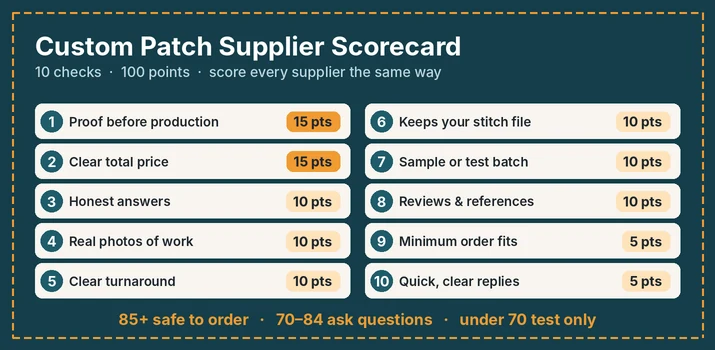
You will rate each supplier on ten things. Each one has a set number of points. Add them up, and you get a score out of 100.
Use the same scorecard for every supplier, so the comparison is fair. Do not score from memory. Write the answers down as you get them.
- They send a proof before making anything: 15 points
- The total price is clear, with no surprise fees: 15 points
- They give honest answers to hard questions: 10 points
- They show real photos of finished work: 10 points
- Turnaround is clear, and they say when the clock starts: 10 points
- They keep your stitch file for reorders: 10 points
- They offer a sample or small test batch: 10 points
- They have reviews or references you can check: 10 points
- The minimum order fits your needs: 5 points
- They reply quickly and clearly: 5 points
Total: 100 points
Notice that the proof and the price carry the most points. That is on purpose. Those two things cause most of the pain in bulk orders.
How to Score Each Question
For each question, give full points, half points, or zero. Here is what each one looks like.
1. Proof Before Production (15 points)
A proof is a picture of your finished patch, shown before it is made. You check it, and then you approve it.
- Full points: They send a proof every time, and you can ask for changes.
- Half points: They send a proof, but it costs extra, or changes are limited.
- Zero: They make it without showing you first.
When the proof arrives, read it like a contract. Check the spelling letter by letter. Check the size in real measurements. Check the thread colors, the border, the backing, and where the patch will sit. Keep the approved proof until your order arrives.
2. A Clear Total Price (15 points)
The price per patch is only part of the cost. Setup fees, digitizing fees, proof fees, backing upgrades, rush fees, and shipping can all be added on top. Some buyer comparisons put these extras at $40 to $150 on an order of 100 patches.
- Full points: They give you one total price with everything included.
- Half points: The price is clear, but a few fees are added later.
- Zero: The price is vague, or you only learn the real cost at checkout.
Ask each supplier this exact question: “What is the total I will pay, including shipping, from approval to my door?â€
3. Honest Answers to Hard Questions (10 points)
Send every supplier the same tricky question. For example: “My logo has nine colors and some tiny text. What would you change?â€
- Full points: They tell you what will not work and offer a fix.
- Half points: They answer, but only in general terms.
- Zero: They say “no problem†to everything, or ignore the question.
The supplier who tells you something you did not want to hear is usually the one you can trust.
4. Real Photos of Finished Work (10 points)
- Full points: They show real patches, with stitching and edges you can see, including some similar to yours.
- Half points: They have some real photos, but mostly mockups.
- Zero: Only stock images or computer mockups.
5. Clear Turnaround (10 points)
Suppliers count time in different ways. Some start the clock when you pay. Others start it when you approve the proof. That difference can cost you a week.
- Full points: They give a time range and say exactly when the clock starts.
- Half points: They give a time range but do not say when it starts.
- Zero: No clear time at all.
6. They Keep Your Stitch File (10 points)
When a supplier turns your artwork into stitch instructions, that file is saved. This matters when you reorder, because it helps the colors and sizes match. If you want to know more about how this step works, read about embroidery digitizing.
- Full points: They keep the file and tell you how reorders work.
- Half points: They keep it, but cannot say whether your reorder will match.
- Zero: They do not keep it, or will not say.
7. A Sample or Test Batch (10 points)
For a large order, a small test saves a lot of money. Order 10 to 25 patches first. Sew one onto the real item. Wash it five times. Tug the edges.
- Full points: They offer a sample or a small batch at a fair price.
- Half points: They offer one, but it is slow or costly.
- Zero: No sample, and a high minimum.
8. Reviews and References (10 points)
- Full points: Reviews mention details, including a problem that was fixed. They can also give you two references for similar orders.
- Half points: There are reviews, but they are short and all say the same thing.
- Zero: No reviews and no references.
9. Minimum Order (5 points)
- Full points: The minimum is clear and fits your needs.
- Half points: It is clear, but higher than you want.
- Zero: It is not stated anywhere.
10. Quick and Clear Replies (5 points)
- Full points: They reply fast, and answer every part of your question.
- Half points: Replies are slow, or answer only part of it.
- Zero: Copy and paste replies, or silence.
A Worked Example
Here is how it looks with three made up suppliers. These numbers are for illustration only. Say you need 200 embroidered patches.
Step 1: Compare the Total Cost
- Supplier A: $1.80 per patch, $40 digitizing fee, $20 proof fee, $35 shipping. Total cost: $455
- Supplier B: $2.10 per patch, digitizing included, proof included, shipping included. Total cost: $420
- Supplier C: $1.95 per patch, digitizing included, proof not offered, $25 shipping. Total cost: $415
Look what happened. Supplier A looked cheapest at $1.80. After the extras, it cost the most. Supplier C had the lowest total, but it offered no proof.
Step 2: Run the Scorecard
- Supplier A: 62/100. Proof 7, total price 7, honest answers 5, real photos 10, turnaround 5, stitch file 5, sample 10, reviews 5, minimum 5, replies 3.
- Supplier B: 100/100. Proof 15, total price 15, honest answers 10, real photos 10, turnaround 10, stitch file 10, sample 10, reviews 10, minimum 5, replies 5.
- Supplier C: 32/100. Proof 0, total price 15, honest answers 0, real photos 5, turnaround 5, stitch file 0, sample 0, reviews 5, minimum 5, replies 2.

Supplier B costs $5 more than Supplier C. But it has a proof, honest answers, and a saved stitch file. Supplier C might save you $5 and cost you the whole order. The scorecard shows that clearly, which a price comparison alone never would.
What Your Score Means

- 85 to 100: Safe to order. Go ahead, but still run a small test if the order is large.
- 70 to 84: Good, with questions. Ask about the points you lost. If they fix them, you are fine.
- Under 70: Think twice. Order only a small test batch, or choose someone else.
- Under 50: Walk away. Missing a proof or hiding the real price on a bulk order is not worth the risk.
What to Do Before You Start Scoring
The scorecard works best when you give every supplier the same information. Write a short brief first: the size in inches, the patch type, the backing, the quantity, and the date you need them.
If you have not chosen a type yet, think about the job. A badge that gets washed every week is a good fit for embroidered patches, since the stitched thread holds up well. If your logo is blurry or only exists as a photo, ask whether the supplier can clean it up. That is what a vector art service does.
Want to See How Others Compare?
If you would like to see more criteria and how different suppliers stack up, our guide to the best custom patch companies in the USA is a good next read.
Frequently Asked Questions
How do I choose a custom patch supplier for a bulk order?
Score each supplier on the same ten questions, including proof, total price, honest answers, real photos, and a test batch. Choose the one with the highest score.
What is the most important thing to check?
A proof before production and a clear total price. Those two cause most problems in bulk orders.
Should I order a sample first?
For large orders, yes. Order 10 to 25 patches, sew one on, wash it a few times, and check it before you commit.
How do I compare quotes fairly?
Ask each supplier for the total cost, including digitizing, proof fees, backing, shipping, and rush charges. Do not compare only the price per patch.
What score should a supplier get before I order in bulk?
Aim for 85 or more. Between 70 and 84, ask questions first. Below 70, only order a small test.
Will my reorder match my first batch?
Ask whether the supplier keeps your stitch file, and whether small differences between batches are normal.
Ready to Compare Us?
Go ahead and run us through the scorecard. Browse our custom patches to see our types, backings, and options, then ask us the hard questions. StitchKrafts USA is based in Austin, Texas, and works with clubs, schools, and businesses across the country.