

How to Sew a Patch on Denim Without It Puckering
Quick answer: To sew a patch on denim without puckering, pin it flat, sew small and even stitches, and keep your thread loose enough that the denim lies flat. Do not pull the thread tight. If your jeans are stretchy, add a piece of stiff fabric behind the spot first, so the denim cannot wrinkle.
Denim is strong, but it is not always easy. A patch that looks flat at first can start to bunch up once you wash it. This guide shows you why it happens, and how to stop it.
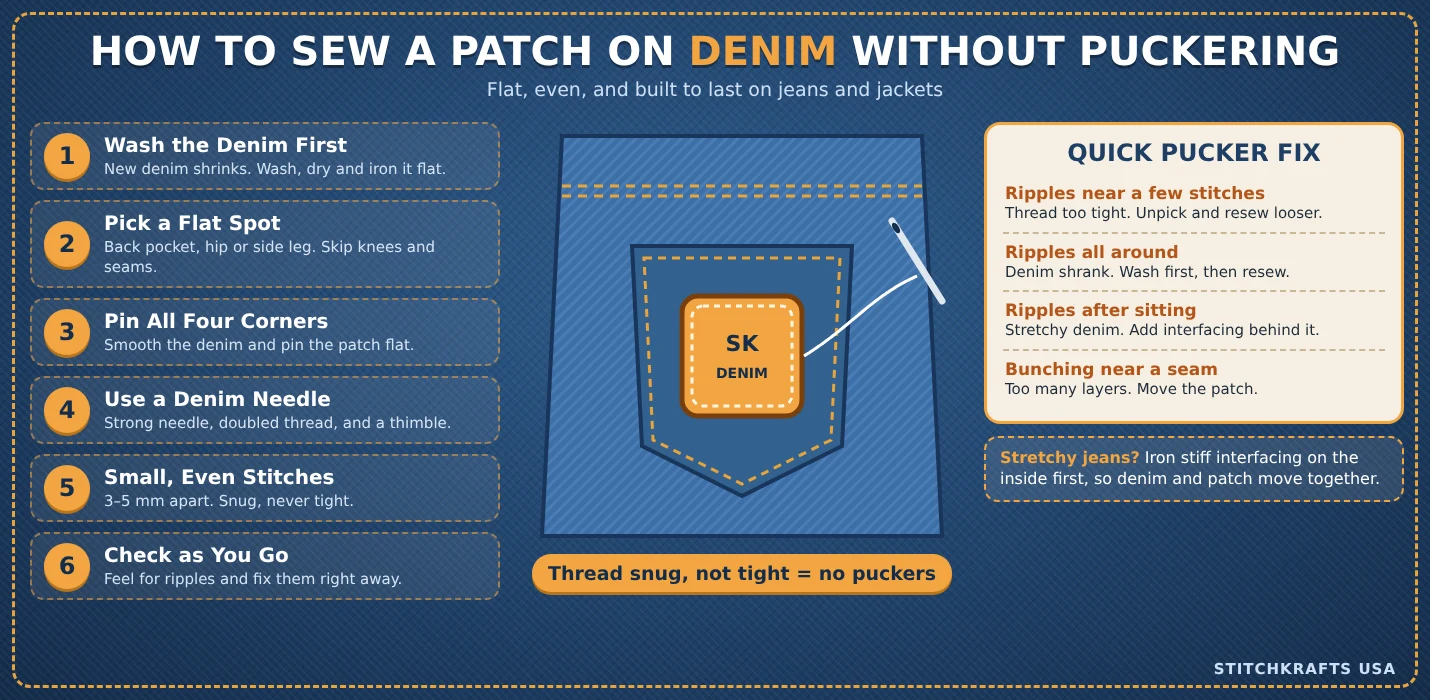
The Short Version: 6 Quick Steps
- Wash the denim first. This stops it shrinking later.
- Pick a flat spot. Stay away from seams and stretchy areas.
- Pin the patch flat, in all four corners.
- Sew small, even stitches with a strong needle.
- Keep the thread loose, not tight.
- Check as you go, and fix puckers straight away.
That is the quick way. Now let’s look at each step, and why it matters.
The Long Version: Every Step Explained
Step 1: Know Why Denim Puckers
A pucker is a small bump or ripple around the patch. It happens for three main reasons.
- The thread is pulled too tight. A tight stitch drags the denim inward, like pulling the strings on a bag. The more stitches you pull tight, the more the denim bunches up.
- The patch and the denim do not match. A patch is usually stiff, and denim is soft and bendy. When you wear the jeans, the denim moves, but the patch does not. The stitches get stretched, and the denim wrinkles around the edge.
- The denim shrinks. New jeans can shrink when you wash them. The patch does not shrink, so the denim pulls up around it.
Once you know the reasons, each fix makes sense.
Step 2: Wash Your Denim First
This is the step most people skip, and it matters a lot. If the jeans or jacket are new, wash and dry them before you sew anything on.
Why? Because new denim shrinks the first time you wash it. If you sew first and wash later, the denim shrinks around a patch that cannot shrink, and you get puckers.
Wash it the way you will wash it in real life. Then let it dry fully, and iron it flat. Now it will not change after you sew.
Step 3: Check If Your Denim Is Stretchy
Look at the label inside your jeans. If it says elastane, spandex, or lycra, your denim has stretch.
Stretchy denim is the biggest cause of puckering. When you sit down or bend your knee, the denim stretches. The patch does not. After a few wears, you see ripples around the edges.
If your denim is stretchy, do two things:
- Put the patch where there is less stretch, like a back pocket, a hip, or the side of the leg. Avoid knees and the seat.
- Add support behind the fabric, which we explain in Step 4.
Step 4: Add Support Behind the Denim (For Stretchy Fabric)
This trick is simple, and almost no guide mentions it.
Cut a piece of stiff, iron on interfacing a little bigger than the patch. You can buy it in any craft shop. Press it onto the inside of the denim, right behind where the patch will go.
This makes that spot stiff, just like the patch. Now the denim and the patch move together, and the denim cannot wrinkle.
For thick, rigid denim, you do not need this step.
Step 5: Pin the Patch Flat
Lay the jeans or jacket flat on a table. Smooth the denim with your hand.
Put the patch where you want it. Push a pin through each corner, then add a few more along the edges. Place the pins straight, pointing in from the edge.
Step back and look at it. Is it straight? Is it in the right place? It is much easier to move a pin than to unpick stitches.
If you do not like pins, a little fabric glue stick or a strip of double sided tape also holds a patch in place while you sew.
Step 6: Use the Right Needle and Thread
Denim is thick, so a thin needle will bend or snap. Use a strong needle made for denim or heavy fabric. A thimble helps too, since you need to push hard.
Use strong thread. Double it up for extra strength. Pick a color that matches the border of the patch, so the stitches blend in.
Step 7: Sew Small, Even Stitches
Start from the inside of the jeans, so the knot is hidden. Push the needle up through the denim and the edge of the patch. Then push it back down right next to it.
Keep your stitches small, about 3 to 5 millimeters apart. Try to make them all the same size.
Here is the most important part. Pull the thread until it is snug, but not tight. The patch should sit flat. If you see the denim starting to pull, loosen it.
A safety tip for jeans: When you sew a pant leg, put your hand inside the leg, so the needle cannot catch the other side. If you do not, you can sew the front and back of the leg together.
Step 8: Check as You Go
Every few inches, stop. Run your hand over the denim. Does it feel flat? Can you see any ripples?
If you spot a small pucker, stop and fix it right then. Take out the last two or three stitches. Smooth the denim. Sew them again, a bit looser.
It is much easier to fix a pucker early than to unpick half the patch later.
Step 9: Add Extra Stitches to the Corners
Corners get pulled the most. When you finish going around, add two or three extra stitches at each corner.
Do not add too many. A crowd of stitches in one tiny spot can cause a pucker of its own.
Step 10: Tie Off and Press
Tie a strong knot on the inside of the denim. Trim the thread close to the knot.
Then flip the jeans inside out. Put a cloth over the patch area, and press with a warm iron for a few seconds. This helps the stitches settle and the denim relax. Do not iron the front of the patch directly, since some patches can melt.
Quick Fix Guide: What Does Your Pucker Look Like?
Match what you see to the cause, then use the fix.
Small ripples near a few stitches
- Likely cause: Thread pulled too tight there.
- Fix: Unpick that section, sew it looser.
Ripples all around the patch
- Likely cause: Denim shrank after sewing.
- Fix: Wash first next time; unpick and resew after washing.
Ripples after sitting or bending
- Likely cause: Stretchy denim.
- Fix: Add stiff interfacing behind the spot.
Patch looks bigger than the denim
- Likely cause: Patch is too stiff for the spot.
- Fix: Move to a flatter area, or use a softer patch.
Bunching near a seam
- Likely cause: Too many layers of fabric.
- Fix: Move the patch away from the seam.
Where to Put Your Patch on Denim
- Good spots: the back pocket, the front hip, the side of the leg, and the chest or sleeve of a jacket. They are flat and move less.
- Tricky spots: knees, the seat, and anywhere close to a seam. These bend a lot or have thick layers, so puckers appear faster.
Choosing the Right Patch for Denim
Denim is thick and strong, so it works best with a patch that is also tough. A good quality denim patch is made to match the weight and feel of jeans and jackets, which helps the patch and the fabric move together.
Sew On or Iron On?
Sewing is stronger and lasts longer on denim, especially for jackets and jeans that get washed a lot. Iron on is faster, but it can peel over time.
If you want to know more about the iron on method, our guide on how to iron on patches without ruining your clothes covers it step by step. For more help on jackets, see how to put a patch on a jacket. And if you want a second set of instructions for jeans, read our guide on sewing a patch on jeans.
Common Mistakes to Avoid
- Pulling the thread too tight.
- Skipping the pre wash on new denim.
- Putting a stiff patch on a knee or seat.
- Using a thin needle that bends.
- Not putting a hand inside the pant leg.
- Adding too many stitches in the corners.
- Waiting until the end to look for puckers.
Frequently Asked Questions
Why does my patch pucker on denim?
Usually because the thread is pulled too tight, the denim shrank after sewing, or the denim has stretch and the patch does not.
How do I stop a patch from puckering on stretchy jeans?
Press a piece of iron on interfacing behind the spot, and place the patch on a low stretch area like a back pocket or hip.
Should I wash jeans before sewing on a patch?
Yes, especially if they are new. Washing first lets the denim shrink before the patch goes on.
Can I fix a patch that has already puckered?
Yes. Unpick the stitches near the pucker, smooth the denim flat, and sew that part again with looser thread.
What size stitches should I use on denim?
Small and even, about 3 to 5 millimeters apart, with thread that is snug but not tight.
What kind of needle is best for sewing a patch on denim?
A strong needle made for denim or heavy fabric, plus a thimble, since you need to push hard through the layers.
Need a Patch Made for Your Denim?
If you want a patch built to sit flat and last on jeans and jackets, our denim patches are made for exactly this. Whether you are in Austin or anywhere else in the country, StitchKrafts USA can help you choose the right size and style before you order.